


Have you ever stared up at the vast, star-dusted canvas above and felt a mix of pure awe and utter confusion? That incredible, ink-black dome is more than a random scattering of lights; it’s a celestial map filled with ancient stories and amazing cosmic wonders. For countless generations, humanity has found direction and inspiration in the sky the night reveals. Yet, it’s easy to feel overwhelmed, wondering if you need an expensive telescope just to tell a planet from a star or to find anything at all through the city glow.
This guide is your personal launchpad. Forget the complex charts and intimidating equipment. We are here to unlock the universe of possibilities waiting right outside your door. Prepare to embark on a magical adventure as we show you the simple secrets to identifying planets, tracing your first constellations, and feeling that profound sense of connection to the cosmos. Your journey to becoming a stargazer begins tonight, armed with nothing more than your curiosity.
What Can You See in the Night Sky? A Celestial Tour
When you look up, the velvet canvas of the cosmos comes alive with a stunning spectacle of light. This is your personal invitation to a universe of possibilities, a journey that begins with a single glance. The sheer variety of celestial objects can seem overwhelming, but learning to navigate them is an amazing adventure. This tour is your first step into the incredible world of stargazing, a hobby that connects us to the cosmos. For a comprehensive overview of amateur astronomy, you’ll find a wealth of information to guide your explorations of everything the night sky reveals.
Stars vs. Planets: The Telltale Twinkle
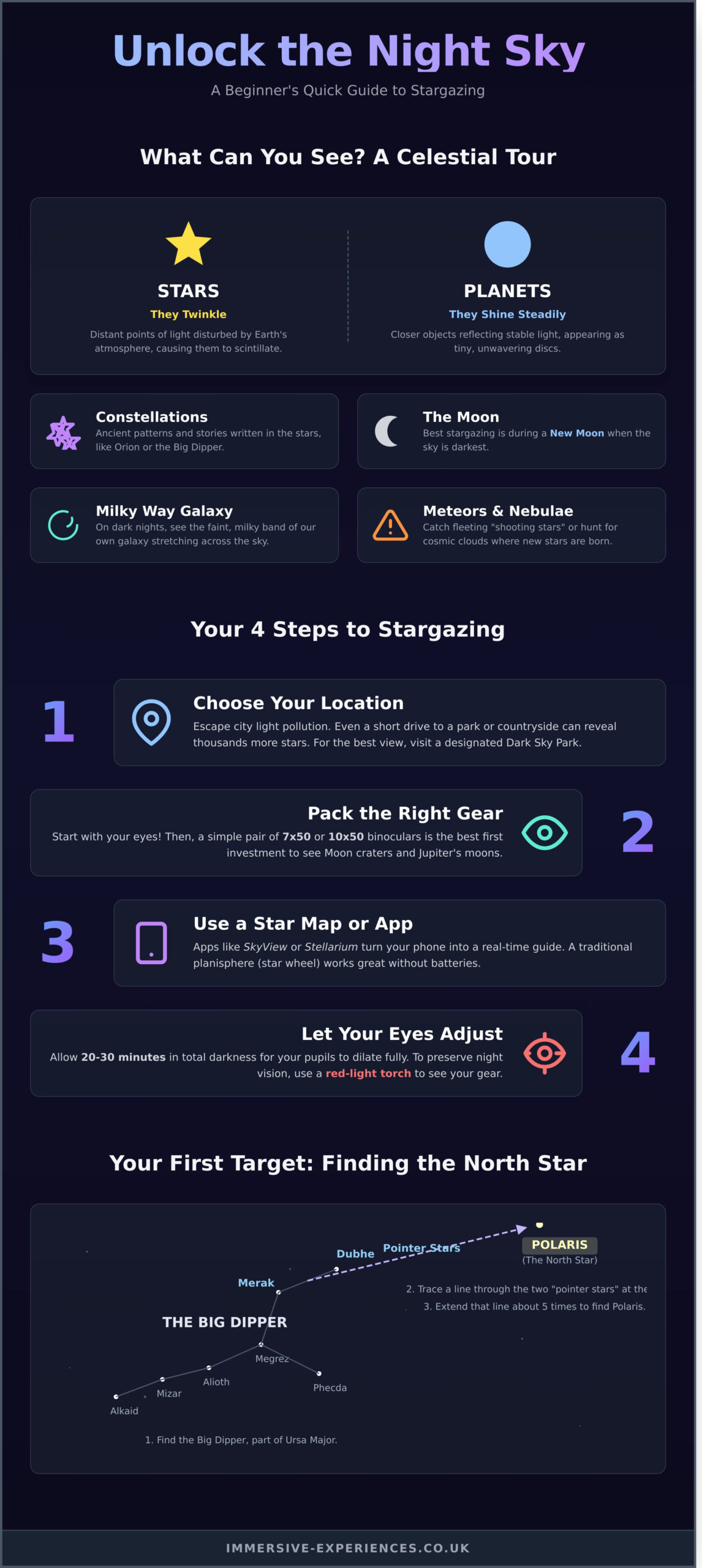
Ever wondered if that bright light is a distant star or a neighbouring planet? Here’s a simple trick: look for a twinkle. Stars are so far away that their light reaches us as a tiny point, easily disturbed by Earth’s turbulent atmosphere, causing it to scintillate. Planets, being much closer, appear as tiny discs. Their reflected light is more stable and shines with a steady, unwavering glow. This is the easiest and most immediate way to identify the key players above.
Constellations: Ancient Stories in the Stars
For millennia, humans have connected the dots to form constellations, using them as calendars, navigational aids, and the heart of epic mythologies. These familiar patterns, like the mighty Orion or the unmistakable Big Dipper, are not clusters of physically related stars. Instead, they are simply line-of-sight alignments from our perspective on Earth-celestial storybooks written across the heavens for us to read.
The Moon: Our Constant Companion
Our planet’s loyal satellite, the Moon, is the most dominant feature in our night sky. As it orbits Earth, it moves through phases-from a sliver-like crescent to a brilliant full disc. While a full moon is a stunning sight, its bright glare acts like natural light pollution, washing out fainter stars and deep-sky objects. For the most dazzling stargazing experience, plan your viewing around the new moon, when the sky is at its darkest.
Beyond the Basics: Galaxies, Nebulae, and Meteors
Once you’ve mastered the fundamentals, a deeper universe awaits. On a clear, dark night, you might spot a faint, milky band stretching across the sky-that’s the Milky Way, our home galaxy seen from the inside! You may also catch the fleeting magic of a meteor, or “shooting star,” as a tiny space rock burns up in our atmosphere. With a pair of binoculars, you can even begin to hunt for nebulae: vast, ethereal clouds of gas and dust where new stars are born.
Getting Started with Stargazing: Your First Steps
Embarking on your cosmic journey is simpler and more rewarding than you might imagine. The universe doesn’t require an expensive ticket for admission; it only asks for your curiosity. Before you even think about complex equipment, these practical first steps will transform your view of the night sky from a simple scattering of dots into a stunning, interconnected celestial map. Your adventure into the cosmos starts now.
Choosing the Right Location: Escaping City Lights
The biggest challenge for any modern stargazer is light pollution-the pervasive glow from our cities that veils the cosmos in a hazy curtain. To truly appreciate the incredible tapestry the sky the night reveals, you need darkness. Even a short drive to a local park or a countryside clearing away from streetlights can unveil thousands more stars. For a truly breathtaking experience, plan a trip to an officially designated Dark Sky Park, a sanctuary for pristine, star-filled skies.
Essential Gear: From Your Eyes to Binoculars
Your adventure begins with the most powerful optical instruments you already own: your eyes. Naked-eye stargazing is the foundation of astronomy, connecting you directly to the constellations our ancestors charted. When you’re ready to magnify your view, a simple pair of binoculars (a 7×50 or 10×50 model is ideal) is the best first investment. They are perfect for exploring the Moon’s craters, spotting Jupiter’s moons, and resolving dense star clusters. This simple, low-cost approach is a cornerstone of successfully getting started with stargazing, allowing you to learn the celestial roadmap before considering a telescope for a deeper dive.
Using Star Maps and Apps: Your Digital Guide
Navigate the celestial ocean with a personal guide in your pocket. Modern apps like SkyView and Stellarium transform your smartphone into a magical window to the cosmos. Simply point your phone at an object, and they use your device’s GPS and sensors to identify stars, planets, and constellations in real-time. For a more traditional, battery-free experience, a planisphere (or star wheel) is a timeless and effective tool for mapping the stars on any given night.
Letting Your Eyes Adjust: The Key to Seeing More
Your eyes have a hidden superpower: dark adaptation. It takes about 20-30 minutes away from bright lights for your pupils to fully dilate, revealing a universe of fainter objects. Patience is your greatest ally here. To protect this precious night vision when you need to check a map or your gear, use a red-light torch, as red light has a minimal impact on your eyes’ sensitivity. One quick glance at a bright white phone screen can reset the entire process!
A Tour of the Most Famous Constellations to Find Tonight
Ready to transform random dots of light into legendary heroes and mythical beasts? Your journey begins now. These celestial signposts are your first, amazing step to navigating the cosmos. Learning to read the patterns that sky the night is like unlocking a secret map written in starlight, turning a glance upward into an incredible adventure.
The Big Dipper and the North Star (Polaris)
This famous asterism, part of the larger constellation Ursa Major (the Great Bear), looks like a giant cosmic saucepan and is your ultimate guide in the northern hemisphere. To perform your first act of star-hopping, trace a line through the two stars at the end of the Dipper’s ‘bowl’ (Merak and Dubhe). Extend that line about five times, and it points directly to Polaris, the North Star-an anchor in the heavens that remains fixed while everything else revolves around it.
Orion the Hunter: A Winter Spectacle
Arguably the most spectacular constellation, Orion dominates the winter sky. You can’t miss his most famous feature: a perfectly straight line of three bright stars forming his belt. From there, your eyes can explore this celestial giant.
- Betelgeuse: A fiery red supergiant marking his right shoulder.
- Rigel: A brilliant, blue-white supergiant forming his left knee.
- The Orion Nebula: Look just below the belt. A faint, fuzzy patch in his ‘sword’ is this incredible stellar nursery where new stars are being born right now.
Cassiopeia the Queen: The ‘W’ in the Sky
Look on the opposite side of Polaris from the Big Dipper, and you’ll find a striking ‘W’ or ‘M’ shape, depending on the season. This is Cassiopeia. In Greek mythology, she was a vain queen banished to the heavens. Because she is circumpolar from many northern latitudes, she and the Big Dipper endlessly circle Polaris like celestial dance partners. Finding one is a fantastic trick for finding the other as you explore the sky.
The Planets of Our Solar System: The Celestial Wanderers
While the distant stars appear fixed in their constellations, a few special lights chart their own majestic paths across the heavens. Ancient observers called them planetes, Greek for “wanderers,” and we know them today as planets. This celestial ballet is a stunning spectacle, and you can witness it yourself. With just your eyes, you can spot five of our solar system neighbours as they journey across the sky the night, each with its own unique personality.
Spotting Venus and Mercury: The Morning & Evening Stars
Tethered by gravity, these two inner planets never stray far from the Sun’s glare. This means you’ll only ever find them hugging the horizon in the twilight hours, making a brief but brilliant appearance just before sunrise or after sunset.
- Venus: The undisputed queen of the planetary world. After the Sun and Moon, it is the most brilliant object in our sky-a dazzling, steady beacon of silvery-white light that is impossible to miss when visible.
- Mercury: A more elusive and challenging prize. As the closest planet to the Sun, it’s often lost in the solar glow, appearing as a faint, star-like point of light for just a few weeks at a time.
Mars: The Distinctive Red Planet
There is no mistaking Mars. This captivating world announces its presence with an unmistakable and fiery reddish-orange hue, a direct result of the iron oxide (rust) covering its surface. Its brightness changes dramatically in our sky, appearing as a modest star at times and a brilliant, blazing jewel when its orbit brings it closest to Earth.
Jupiter and Saturn: The Gas Giants
The colossal kings of our solar system command attention. Jupiter shines with a powerful, brilliant-white light and, unlike stars, its light is steady and does not twinkle. It is often the brightest “star” in the sky when Venus is not present. The more distant Saturn glows with a calmer, yellowish-white light. While its magnificent rings are invisible to the naked eye, their stunning beauty can be revealed with a good pair of binoculars or any small telescope.
The positions of these wanderers are always changing, making every evening a unique viewing opportunity. To find out exactly where to look when you next scan the sky the night, we recommend using a modern stargazing app. It’s like having a pocket planetarium! For an even more incredible view, discover the cosmos with our award-winning mobile planetarium experiences, bringing the universe right to you.
Bringing the Cosmos Down to Earth: The Planetarium Experience
There is a unique magic in tilting your head back and gazing at the stars from your own backyard. But this personal journey is often challenged by frustrating realities: city lights washing out the Milky Way, unpredictable weather obscuring the view, and the sheer scale of it all feeling overwhelming. What if you could have a perfect, uninterrupted view of the cosmos, guided by an expert, and travel to its furthest reaches? This is where the modern planetarium experience transforms our relationship with the universe, offering an incredible, immersive gateway to the stars.
A Perfect View, Whatever the Weather
Imagine a crystal-clear view of the cosmos, guaranteed every single time. A mobile planetarium eliminates the astronomer’s greatest foes: cloudy skies and light pollution. Inside our state-of-the-art domes, the faint glow of city life vanishes, replaced by a stunningly dark canvas. Suddenly, thousands of stars, distant nebulae, and the breathtaking arc of the Milky Way are revealed in vivid detail-a perfect representation of the sky at night that most people have never seen before.
A Guided Tour with an Expert Astronomer
While stargazing apps are useful, they can’t replace the passion and knowledge of a live guide. Our planetarium shows are led by expert presenters who don’t just show you the stars; they tell their stories. This is your chance to ask those burning questions in real-time and get answers that spark even more curiosity. Instead of just identifying constellations from a chart, our astronomers help you truly sky the night, connecting the dots and revealing the science and mythology woven into the heavens in a dynamic, interactive show.
Journey to Places You Can’t See from Home
A planetarium does more than just show you the sky above; it’s a vehicle for cosmic exploration. Our cutting-edge fulldome technology allows us to lift you off the Earth and fly you through the solar system. You can soar through the majestic rings of Saturn, witness the birth of a star in a stellar nursery, or travel millions of light-years to visit the Andromeda Galaxy. It’s an amazing opportunity to gain a new perspective on the universe and our place within it. Bring the universe to your school or event.
Your Journey into the Cosmos Has Just Begun
You now possess the foundational knowledge to begin your own celestial adventure. From your first steps in finding a dark spot to identifying the most famous constellations and spotting planets wandering across the ecliptic, you’ve learned that you don’t need complex gear to appreciate the wonders that sky the night. This guide is your launchpad into a universe of discovery, right from your own backyard.
Ready to dive deeper and experience the universe in a truly stunning, immersive way? Immersive Experiences brings the cosmos directly to you with our state-of-the-art mobile planetariums. Join the over 1 million people worldwide who have been captivated by our award-winning educational shows. As the operators of the world’s largest fleet of mobile planetariums, we deliver unforgettable, magical journeys through space and time. Discover our incredible mobile planetarium experiences!
The universe is waiting. Look up, stay curious, and never stop exploring the magnificent tapestry above.
Your Cosmic Questions Answered: Stargazing FAQs
What is the difference between astronomy and astrology?
Astronomy is the incredible science dedicated to studying everything beyond Earth’s atmosphere, including stars, planets, and galaxies. It relies on physics and mathematics to understand the universe. Astrology, however, is a belief system suggesting that the positions of celestial objects influence human affairs. While it has ancient roots and cultural significance for many, it is not a science and its principles are not supported by scientific evidence. One is a journey of discovery, the other a system of divination.
Can I see the Milky Way from my city?
Witnessing the Milky Way from within a city is exceptionally difficult due to light pollution. The bright glow of urban areas washes out the faint, ethereal light of our galaxy’s core. To experience this breathtaking sight, you must venture to a remote location with minimal artificial light, such as a national park or designated dark sky reserve. On a clear, moonless evening in a truly dark place, the Milky Way will reveal its stunning, hazy arc across the sky the night.
What is a ‘shooting star’ really?
A ‘shooting star’ is a magical sight, but it isn’t a star at all! The correct term is a meteor. This brilliant, fleeting streak of light is created when a tiny particle of space dust or rock, called a meteoroid, enters Earth’s atmosphere at immense speed. The intense friction causes it to heat up and vaporize, producing a spectacular flash. It’s a momentary, dazzling light show courtesy of cosmic debris, often no bigger than a grain of sand.
How do I tell the International Space Station (ISS) from an airplane?
Spotting the ISS is a thrilling experience! The key difference is its light. The ISS shines with a constant, bright, steady light and does not blink or flash like an airplane. It moves very quickly and silently across the sky the night, often crossing from one horizon to the other in just a few minutes. If you see flashing red and green lights or hear the sound of an engine, you are definitely looking at a much closer aircraft.
What are the best months for stargazing in the UK?
The UK offers amazing stargazing opportunities, but the prime season is from September to March. During these autumn and winter months, the nights are longer and the air is often colder and less hazy, providing crystal-clear views of iconic constellations like Orion and the Andromeda Galaxy. For the best chance to see the Milky Way’s core, look south during the dark, moonless nights of summer, particularly in July and August, well after midnight has passed.
Do I need a telescope to see Saturn’s rings?
While you can see the planet Saturn with your naked eye-appearing as a bright, steady, yellowish point of light-you absolutely need magnification to see its magnificent rings. A good pair of binoculars might reveal that the planet has an oblong shape, but to clearly resolve the rings as a distinct feature, you will need a small telescope. Even a basic model with 25-50x magnification can provide a jaw-dropping view that will stay with you forever.