


Have you ever gazed up at the velvet night sky, a breathtaking sea of glittering stars, and felt a profound sense of wonder mixed with a hint of being lost? Many believe that unlocking the universe’s secrets requires complex charts and powerful telescopes, feeling shut out by city lights or simply not knowing where to begin. But what if we told you the greatest show in the universe is free, and your ticket is simply your own curiosity?
Prepare for an incredible adventure. This is your ultimate guide to stargazing, designed to transform you from a curious observer into a confident sky-watcher. Forget the complexity and the expensive gear. We will journey together, showing you how to identify your first constellations and planets with just your eyes, find the perfect dark-sky spots, and plan a magical night that connects you and your family to the cosmos. An entire universe of possibilities awaits, right above your head. Let’s begin the exploration.
Key Takeaways
- You don’t need a telescope to begin your cosmic adventure; learn how to unlock the power of your own eyes with one simple technique.
- Discover how to easily identify your first constellations and other amazing celestial sights visible even from your own backyard.
- Transform your stargazing into an unforgettable experience by mastering the three essential pillars of planning for a perfect night.
- Find out how to enjoy the magic of the universe in any weather and learn how a planetarium can bring the cosmos to you.
Why Stargazing is an Adventure for Everyone
For millennia, humanity has looked to the heavens in awe, seeking answers, inspiration, and a sense of connection. In our fast-paced, digital world, the simple act of looking up is more powerful than ever. It’s a chance to disconnect from glowing screens and reconnect with something truly vast and profound. This is not just a hobby; it’s an incredible experience that offers a powerful shift in perspective, reminding us of our place in an immense and beautiful universe. Best of all, this cosmic adventure is free and accessible to everyone, from curious children to seasoned adults.
The Magic of Looking Up
Stargazing recaptures a sense of childhood wonder that is often lost in daily life. Each clear night presents a unique, live performance on a stunning celestial stage, with a new arrangement of stars, planets, and cosmic events. It’s an amazing opportunity to learn the ancient myths and stories woven into the constellations, transforming a cluster of distant suns into the hero Orion, the great bear Ursa Major, or the graceful swan, Cygnus. The sky comes alive with history and imagination.
An Educational Journey
This incredible journey into amateur astronomy is a living classroom and a gateway to understanding the fundamental principles of physics, chemistry, and history. You can witness celestial mechanics firsthand by tracking the slow dance of planets across the sky or observing the changing phases of the Moon. For young explorers, it is a powerful spark that can ignite a lifelong passion for science, technology, and discovery, proving that the greatest lessons are often written in the stars.
The benefits of this timeless activity are as limitless as the night sky itself. It’s an adventure that costs nothing but rewards you with everything. Whether you are seeking a moment of peace, a family bonding activity, or an intellectual challenge, the universe is waiting.
- Boost Your Well-being: Swap screen time for star time to find calm and practice mindfulness.
- Connect with History: Share a view that has inspired our ancestors for thousands of years.
- Gain Perspective: Feel a profound sense of awe by contemplating the sheer scale of the cosmos.
- Learn for Free: Begin your journey with the most powerful tool you have-your own eyes.
Your Stargazing Toolkit: Starting with Just Your Eyes
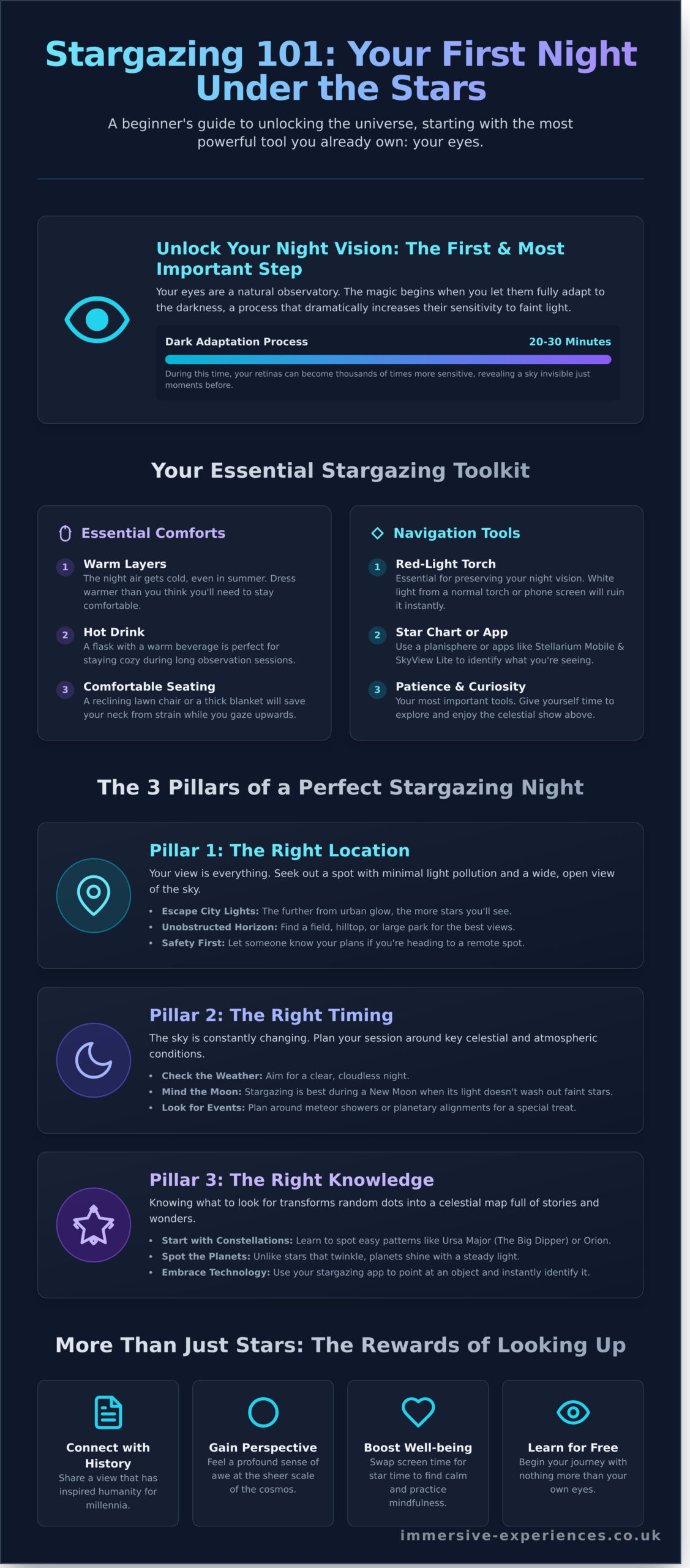
Embark on your cosmic journey with the most powerful and portable observatory you’ll ever own: your own two eyes. Before you even think about telescopes, the first step into the universe of stargazing is simply to look up. The real magic begins when you allow your eyes to fully adapt to the darkness. This incredible biological process, known as dark adaptation, takes about 20-30 minutes. During this time, your pupils dilate and your retinas become thousands of times more sensitive to faint light, revealing a stunning tapestry of stars invisible just moments before.
To protect this precious night vision, avoid all white light. A simple torch covered with red cellophane or a dedicated red-light headlamp is essential for reading charts or finding your way. And don’t forget the terrestrial essentials! The night air can be surprisingly cold, even in summer. Dress in warm layers and consider bringing a flask with a hot drink to make your observation session a truly comfortable and amazing experience.
Navigating the Night: Apps and Star Charts
Once you’re settled, how do you know what you’re seeing? Today’s technology puts a universe of knowledge in your pocket. These tools transform a sky of random dots into a map of constellations, planets, and galaxies.
- Modern Apps: Free apps like Stellarium Mobile and SkyView Lite use your phone’s GPS and compass to create a real-time map of the sky. Just point your device at an object to instantly identify it!
- Classic Charts: A planisphere (a rotating star wheel) or a printed monthly star chart are fantastic, battery-free ways to learn the major constellations and their movements throughout the year.
Preparing for Your First Observation
Your location is everything. An ideal spot has a dark sky, far from the glare of city lights, and a clear, unobstructed view of the horizon. Learning how to find the best places for stargazing is a key skill, and NASA offers expert guidance on escaping light pollution. Once you’ve found your spot, a few final preparations will guarantee a perfect night:
- Get Comfortable: A reclining lawn chair or a thick blanket will save your neck from strain during long periods of looking up.
- Stay Safe: If you’re heading to a remote location, always let a friend or family member know your plans and when you expect to return.
A Beginner’s Guide to the Night Sky: What to Look For
Your journey into the cosmos begins with your own two eyes. The night sky is a vast universe of possibilities, and you don’t need expensive gear to start exploring. The key is to begin with bright, easy-to-find targets that build your confidence and spark your curiosity. Many excellent resources, like The Planetary Society’s beginner’s guide to stargazing, emphasize starting with these foundational skills. Before you head out, learn two simple concepts. First, magnitude refers to an object’s brightness-the lower the number, the brighter the object. Second, you can use your own hand as a ruler: hold your arm out straight, and your fist covers about 10 degrees of the sky, while a fingertip covers about 1 degree. This simple tool is perfect for measuring distances between stars.
Your First Cosmic Targets
Once you’re outside, these incredible objects are your perfect starting points for an amazing evening of stargazing. They are bright, easy to spot, and offer rewarding views without any equipment.
- The Moon: Our closest celestial neighbour is a stunning sight. Observe its changing phases and look for the dark, smooth “seas” (ancient lava flows called maria) and the brighter, cratered highlands.
- Bright Planets: The “wandering stars” of the ancients are surprisingly easy to spot. Venus is the brilliant “evening star,” Jupiter is a powerfully bright beacon, Saturn glows with a steady, yellowish light, and Mars has a distinct reddish hue.
- The International Space Station (ISS): Witness a triumph of human engineering! Use a tracking app to find out when the ISS will fly over your location. It looks like a very bright, fast-moving star gliding silently across the sky.
Finding Your First Constellations
Constellations are your map to the night sky. Start with a prominent “signpost” like The Big Dipper (or The Plough) in the Northern Hemisphere. Its two outer stars in the “bowl” point directly to Polaris, the North Star. From there, you can “star-hop” to find other patterns like the ‘W’ shape of Cassiopeia. Each constellation has a history, and learning the myths behind them is a key part of educational storytelling that brings the stars to life.
Witnessing the Milky Way
On a clear, dark night away from city lights, you can see our own galaxy. The Milky Way appears as a faint, magical, cloudy band stretching across the sky. You are not looking at it, but rather looking through the dense, star-filled plane of our spiral galaxy from our vantage point inside it. For the most spectacular view, look for its bright, shimmering core during the summer months.
Planning Your Perfect Stargazing Session
A truly breathtaking night of stargazing doesn’t happen by accident-it’s a planned adventure! Your success lies in preparation. By mastering three key factors-location, timing, and weather-you can transform a simple glance upwards into an unforgettable cosmic journey. When these elements align, the universe puts on an incredible show just for you.
Escaping the Glow: Finding Dark Skies
The biggest challenge for any aspiring astronomer is light pollution, the artificial glow from our towns and cities that veils the night sky. To witness the true majesty of the cosmos, you must escape this light. Use online light pollution maps to discover nearby parks, nature reserves, or rural “dark sky” sites. Even a short drive away from streetlights can reveal a stunning number of previously invisible stars.
Timing is Everything: Moon Phases and Seasons
The Moon is the sky’s natural spotlight, and its phase dramatically impacts what you can see. For the best views of faint, deep-sky objects like galaxies and nebulae, plan your session around the New Moon, when the sky is at its absolute darkest. A bright Full Moon, while a beautiful spectacle in its own right, will wash out fainter stars, making it the perfect time to focus on stunning lunar craters and seas instead.
Checking the Forecast: Weather and Seeing
A cloudless night is just the beginning. For the sharpest, most detailed views, professional astronomers look for a combination of conditions. When checking the forecast, pay attention to:
- Transparency: How clear and free of haze is the air? Low humidity is your best friend.
- Seeing: How stable is the atmosphere? Calm, steady air (good “seeing”) means stars will twinkle less, allowing you to see crisp details on planets.
Specialised astronomy weather apps provide forecasts for both these factors, giving you a powerful advantage.
Patience is a virtue in stargazing. Not every night will be perfect, but when the conditions are right, the reward is a magical and awe-inspiring view of the universe. For a truly guided journey into the cosmos, explore our incredible mobile planetarium shows, where we bring the stars to you, whatever the weather.
Experience the Universe Up Close: The Magic of a Planetarium
You have your star chart and you’re ready to explore, but what happens when the clouds roll in? Or if you live in a city where light pollution washes out all but the brightest stars? Don’t let these common obstacles dim your curiosity. A planetarium brings the entire universe to you, offering a breathtakingly clear view of the cosmos, anytime and in any weather.
It’s the ultimate way to prepare for your adventures in stargazing. Imagine learning to identify constellations like Orion and Ursa Major in a perfect, simulated night sky before you even step outside. A planetarium experience allows you to journey to the edge of the galaxy, fly through the rings of Saturn, or witness the birth of a star-cosmic phenomena impossible to see with the naked eye, brought to life in stunning, immersive detail.
A Guided Tour of the Cosmos
Step inside a dome and be transported. Unlike simply looking at a screen, a planetarium is a fully shared, 360-degree experience. It’s the perfect environment for anyone curious about the stars, from school groups to corporate teams seeking a touch of wonder.
- Expert Guidance: Our presenters are passionate about astronomy and can answer your questions in real-time, making complex ideas instantly accessible.
- Perfect Skies, Guaranteed: Witness thousands of stars, the Milky Way, and distant galaxies in a perfectly dark environment, free from any light pollution.
- Incredible Visuals: Learn about black holes, nebulae, and planetary orbits through fulldome shows that make you feel like you’re truly there.
An Experience for Everyone
We believe the magic of the universe should be open to all. That’s why our award-winning mobile planetariums can be set up almost anywhere, bringing the adventure directly to your school, office, or venue. We are proud to offer accessible shows tailored for neurodiverse audiences, ensuring a comfortable and captivating experience for every guest. Whether it’s an educational workshop, a corporate function, or spectacular private events and entertainment, we create unforgettable journeys through space.
Ready to see the universe in a completely new light? Discover how an immersive planetarium can transform your understanding of the night sky at immersive-experiences.co.uk.
Your Cosmic Adventure Awaits
The night sky is no longer a mystery, but an open invitation to explore. You’ve discovered that this incredible journey doesn’t require expensive equipment-just your eyes, a touch of planning, and a universe of curiosity. From spotting your first constellation to understanding the dance of the planets, the foundational magic of stargazing is now yours to command.
When you’re ready to transform that newfound passion into an unforgettable spectacle, we’re here to launch you into the cosmos. As the creators of award-winning worldwide planetariums, we’ve delivered over 1 million stunning engagements, earning the trust of global leaders like the BBC, NASA, and Oxford University. We don’t just show you the stars; we bring them within reach in breathtaking, immersive detail. Discover a universe of possibilities with our Immersive Experiences!
The cosmos is vast, and your adventure has only just begun. Go outside tonight and continue your journey. Keep looking up!
Unlock the Cosmos: Your Stargazing FAQs
Do I really need an expensive telescope to start stargazing?
Absolutely not! Your most powerful tools are your own eyes. The journey into stargazing begins by simply looking up to learn constellations and spot bright planets. For a more detailed view, a good pair of binoculars is an amazing and affordable next step. They are perfect for exploring the craters of the Moon, the moons of Jupiter, or the breathtaking star fields of the Milky Way, offering an incredible introduction to the cosmos without a major investment.
How can I see stars and constellations if I live in a big city?
While city lights present a challenge, your urban cosmic adventure is still possible! Seek out darker areas like large parks, rooftops, or hills that offer some shield from direct glare. Focus on the brightest celestial objects, such as the Moon, visible planets like Jupiter and Venus, and prominent constellations like Orion or Ursa Major (The Plough). Planning your viewing around nights with clear, haze-free skies will dramatically improve what you can see from the city.
What is the difference between a star and a planet when I look at them in the night sky?
The easiest way to tell the difference is the “twinkle test.” Stars, being incredibly distant points of light, have their light distorted by Earth’s atmosphere, causing them to twinkle. Planets are much closer, appearing as tiny disks of light. Their reflection of sunlight is more stable as it passes through our atmosphere, so they shine with a steady, unwavering glow. Look for the objects that don’t twinkle-you’ve likely found a planet!
What are the best free mobile apps for identifying stars?
Transform your smartphone into a magical window to the universe! There are several fantastic free apps that use your phone’s location and orientation to identify celestial objects in real-time. We recommend starting with SkyView Lite, Star Walk 2 Free, or Stellarium Mobile Free. Simply point your device at the sky, and these apps will reveal the names of stars, constellations, planets, and even satellites passing overhead. They are an essential tool for any budding astronomer.
When is the best time of year to see the Milky Way in the UK?
To witness the stunning, ethereal glow of our galaxy’s core from the UK, plan your viewing sessions for the summer months. The prime season runs from June to August, on clear, moonless nights. For the most spectacular view, you must travel far from city light pollution to a designated Dark Sky Park. The sight of the Milky Way arching across a truly dark sky is an unforgettable, awe-inspiring experience that connects you directly with the grand scale of our universe.
How long does it take for my eyes to get used to the dark?
Patience is key for an amazing stargazing session! Your eyes need around 20 to 30 minutes to fully “dark adapt,” allowing your pupils to dilate and your eyes to build up the light-sensitive chemicals needed to see faint objects. To protect this precious night vision, avoid looking at bright screens or white lights. A top tip from experts is to use a red-light torch, as red light has a minimal effect on your dark adaptation.