


Have you ever gazed at the star-dusted canvas of the night sky and felt an incredible mix of awe and bewilderment? The story of humanity’s journey into the cosmos is vast, filled with legendary rivalries, breathtaking discoveries, and bold new players changing the game. It’s easy to feel lost among the constellations of facts and figures, from the Space Race to the rise of private companies. But what if you could embark on a clear, thrilling journey through it all? This is your definitive guide to the amazing adventure of space exploration.
Prepare to travel from the flickering black-and-white broadcasts of the first rocket launches to the high-definition streams from rovers on Mars. In this article, we will demystify the pivotal moments of the past, clarify the exciting missions of today’s pioneers, and cast our eyes toward a future where humanity’s footprint may one day mark another world. Get ready to uncover the mysteries of the universe and feel inspired by our ultimate quest for the stars.
Key Takeaways
- Uncover the incredible journey from ancient cosmic myths to the scientific breakthroughs that first launched humanity to the stars.
- Witness the dramatic shift in space exploration from a superpower race to a new era of global collaboration and commercial pioneers.
- Discover the amazing technologies that bring the cosmos to Earth, transforming complex data into breathtaking visuals for everyone to experience.
- Get a stunning glimpse into the next giant leap for humanity, exploring the ambitious missions to Mars and the challenges we must overcome.
From Ancient Stargazers to the Dawn of Rocketry
The story of space exploration is a story about humanity itself. It begins not with engines and equations, but with a primordial human impulse: to look up at the night sky in sheer wonder. For thousands of years, we charted the heavens, weaving tales of gods and heroes into the cosmic ballet. This magical journey from mythological belief to scientific discovery is the foundation upon which every rocket launch is built.
The First Astronomers
Ancient cultures were the world’s first astronomers. Babylonian and Egyptian civilizations meticulously tracked celestial cycles to create calendars and guide agriculture, while Greek thinkers attempted to model the universe. Yet, the cosmos remained distant and divine until the 17th century. It was then that Galileo Galilei pointed his revolutionary telescope skyward, revealing a universe of stunning complexity. Shortly after, Sir Isaac Newton formulated the laws of motion and universal gravitation, providing the mathematical keys to unlock the secrets of celestial mechanics. The heavens were no longer just a map; they were a physical reality governed by predictable laws.
The Pioneers of Rocket Science
While astronomy explained how the planets moved, rocketry promised a way to reach them. The incredible history of spaceflight was built by visionaries who transformed science fiction into scientific fact. This new frontier was forged by a handful of brilliant minds:
- Konstantin Tsiolkovsky: Often called the father of theoretical cosmonautics, this Russian visionary developed the foundational “rocket equation” in 1903, proving that space travel was mathematically possible.
- Robert Goddard: An American physicist who took theory into the field. In 1926, he achieved the impossible, launching the world’s first liquid-fueled rocket-a short but monumental flight that ushered in the age of rocketry.
- Hermann Oberth: A German-Romanian physicist whose influential book, The Rocket into Interplanetary Space, inspired a wave of rocket societies and engineers across Europe, including a young Wernher von Braun.
These pioneers laid the intellectual and practical groundwork for what was to come. Their work tragically found its first large-scale application in Germany’s V-2 rocket, a weapon of war. However, its advanced engine and guidance systems became the undeniable technological blueprint for the American and Soviet rockets that would soon ignite the next chapter of space exploration.
The Space Race: A Giant Leap for Mankind
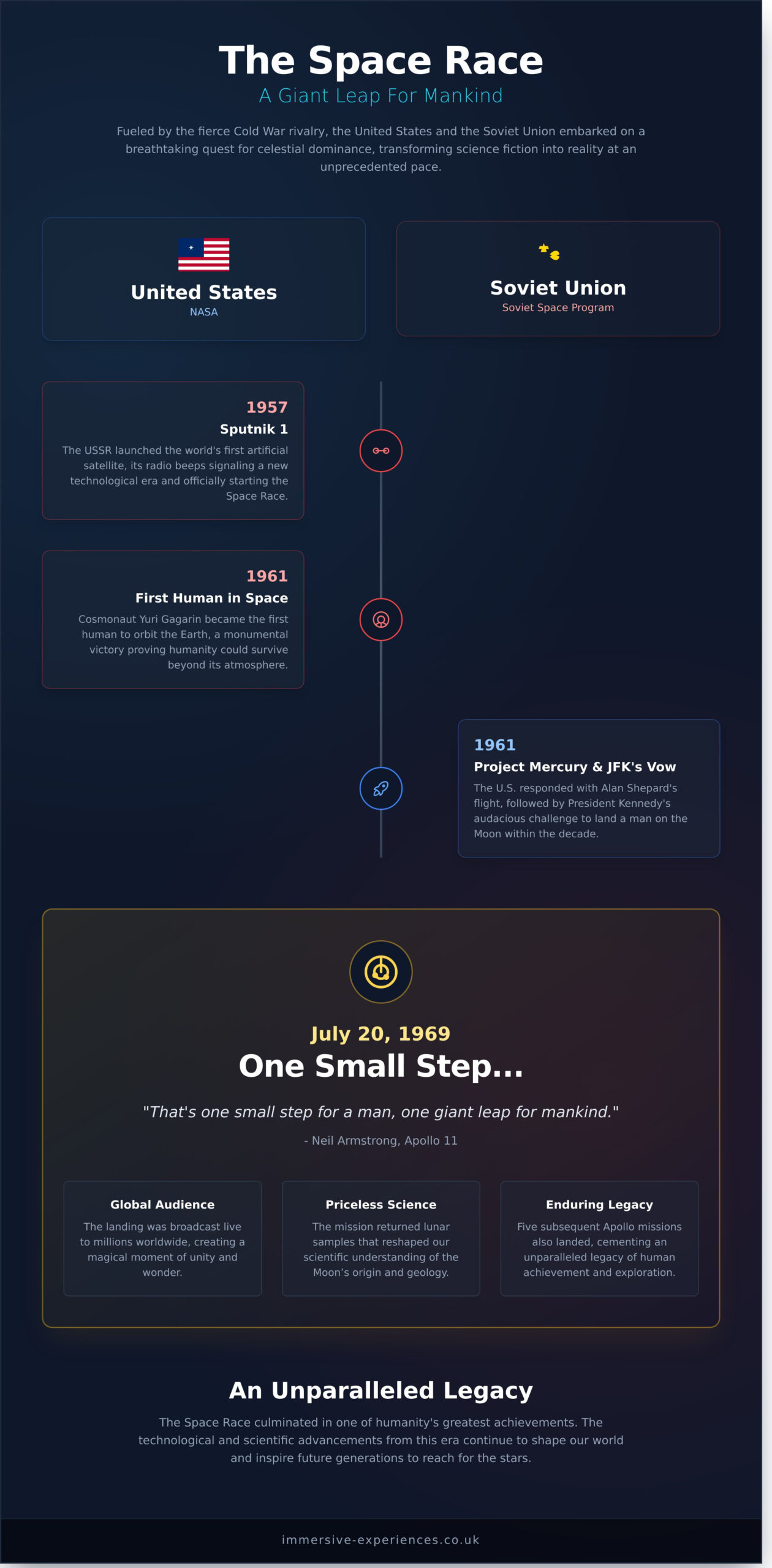
The mid-20th century ignited a dramatic and unprecedented chapter in human history: the Space Race. Fueled by the fierce Cold War rivalry between the United States and the Soviet Union, this era transformed science fiction into scientific fact at a breathtaking pace. It was a period defined not just by technological breakthroughs, but by the sheer audacity of human ambition, pushing the boundaries of what was once thought possible in the quest for celestial dominance and forever changing the course of space exploration.
Key Milestones of the Space Race
The competition was a stunning series of firsts, where each achievement was a national triumph and a challenge to the opposition. The timeline of innovation was truly incredible:
- Sputnik 1 (1957): The race began in earnest when the USSR launched the world’s first artificial satellite. The beachball-sized sphere’s simple radio beeps were a shockwave across the globe, signaling a new technological era.
- First Human in Space (1961): The Soviets scored another amazing victory when cosmonaut Yuri Gagarin became the first human to orbit the Earth, proving that humanity could survive beyond its own atmosphere.
- Project Mercury and JFK’s Vow: The U.S. responded with urgency. Project Mercury, a foundational chapter in NASA’s history of space exploration, sent Alan Shepard into space just weeks after Gagarin. This culminated in President John F. Kennedy’s audacious 1961 challenge: to land a man on the Moon before the decade was out.
One Small Step: Landing on the Moon
On July 20, 1969, the world held its breath as Apollo 11’s Eagle lander touched down on the lunar surface. Neil Armstrong’s first steps, accompanied by his iconic words, “That’s one small step for a man, one giant leap for mankind,” was a magical moment of unity and wonder broadcast to millions. More than a political victory, the mission returned priceless lunar samples that reshaped our understanding of the Moon’s origin. Five subsequent Apollo missions also landed on the Moon, cementing an unparalleled legacy of discovery and human achievement.
The Modern Era: Collaboration, Commerce, and New Frontiers
The 21st century launched an incredible new chapter in space exploration. The political rivalries of the past have evolved into unprecedented global partnerships and a dynamic commercial marketplace, accelerating our journey to the stars. This modern era is defined not by a race between superpowers, but by a collective human drive to explore, understand, and ultimately expand our presence in the cosmos.
The Age of Orbiting Laboratories and Telescopes
The groundwork for this era was laid by NASA’s Space Shuttle program, which enabled the construction of humanity’s greatest orbital outpost: the International Space Station (ISS). A stunning symbol of global cooperation, the ISS continues to host astronauts from numerous nations, conducting vital research in microgravity. High above, the Hubble Space Telescope delivered a revolutionary view of the universe, while its successor, the James Webb Space Telescope, now peers even deeper into cosmic history, on a magical quest to see the universe’s first light.
The Rise of Private Spaceflight
A seismic shift occurred with the arrival of ambitious private companies like SpaceX and Blue Origin. Their development of reusable rocket technology has dramatically slashed the cost of reaching orbit, democratizing access to space. This innovation paved the way for commercial crew flights, with private spacecraft now routinely ferrying astronauts to the ISS. This powerful public-private model is a cornerstone of NASA’s strategic plan for space exploration, fostering a vibrant new economy that includes the emerging market of space tourism.
Robotic Explorers in Our Solar System
While humans work in low-Earth orbit, our robotic emissaries are venturing to the farthest reaches of our solar system and beyond. These incredible machines are our eyes and hands on distant worlds, conducting amazing science:
- Mars Rovers: Generations of rovers, including Spirit, Opportunity, Curiosity, and Perseverance, have scoured the Red Planet for signs of past life.
- Interstellar Pioneers: The legendary Voyager probes have journeyed beyond our solar system, sending back unprecedented data from the void between the stars.
- Outer Planet Missions: The Juno mission orbits Jupiter, unlocking secrets beneath its swirling clouds, continuing a legacy of exploring our gas giants.
- Cosmic Origins: Missions to asteroids and comets analyze pristine materials from the dawn of our solar system, offering clues to our own beginnings.
Bringing the Universe to Earth: How We Experience Space Today
The final frontier is no longer a distant dream reserved for a select few. In this golden age of technological wonder, the grand adventure of space exploration is available to everyone, transforming us all into armchair astronauts on a breathtaking cosmic journey. Incredible advancements are bridging the vast distances of space, translating complex scientific data into stunning, interactive experiences that educate, entertain, and inspire on an unprecedented scale.
Visualising the Cosmos
The awe-inspiring images of swirling nebulae and distant galaxies we admire don’t arrive from space ready-made. They begin as raw data-streams of numbers and light frequencies captured by probes and telescopes like the JWST. Powerful data-rendering software then transforms this information into the vibrant, detailed visuals that fuel our curiosity. This technological magic is brought to life in planetariums, which act as vital gateways to the universe for public science education. Using state-of-the-art fulldome projection, a vast range of immersive 360° shows can transport audiences to the surface of Mars, through the rings of Saturn, or to the edge of a black hole, making complex astronomical concepts tangible and unforgettable.
Stepping into Another World with Immersive Tech
Immersive technology like Virtual and Augmented Reality (VR/AR) is fundamentally changing our connection with the cosmos. This isn’t science fiction; space agencies use these powerful tools to create hyper-realistic simulations for astronaut training, preparing them for the challenges of spacewalks and operating complex machinery in zero gravity. The same groundbreaking technology now allows us to follow in their footsteps. Anyone can book a virtual reality experience to explore distant worlds, pilot a spacecraft, or witness cosmic events firsthand. These shared, powerful events for schools and the public create unforgettable, curriculum-linked learning moments that spark a lifelong passion for discovery.
By making the universe accessible and profoundly interactive, these technologies are doing more than just showcasing the wonders of our solar system; they are actively building the future of space exploration. They ignite the imaginations of the next generation of scientists, engineers, and dreamers, ensuring that humanity’s quest for the stars continues to burn brightly for decades to come. Discover how to bring these incredible experiences to your audience by visiting us at immersive-experiences.co.uk.
The Future of Space Exploration: To Mars and Beyond
The next chapter of humanity’s cosmic journey is already being written. A stunning collaboration between national agencies and pioneering private companies is pushing the boundaries of what’s possible, setting sights on destinations that once belonged only to science fiction. This new era of space exploration is not just about planting flags; it’s about building a sustainable future among the stars.
Return to the Moon, Onward to Mars
The immediate horizon is dominated by our return to the Moon. NASA’s ambitious Artemis program aims to establish a sustainable human presence on the lunar surface, creating a vital proving ground for deep-space technologies. This lunar base will serve as a stepping stone for the ultimate goal: Mars. However, the journey to the Red Planet presents immense challenges, from protecting astronauts from cosmic radiation to overcoming the psychological hurdles of long-duration flight. Meanwhile, companies like SpaceX are developing revolutionary vehicles like Starship, with the incredible goal of making humanity a multi-planetary species.
The Search for Life Beyond Earth
Are we alone in the universe? This profound question drives some of our most advanced scientific missions. Powerful instruments like the James Webb Space Telescope are peering into the atmospheres of distant exoplanets, searching for “biosignatures” – tantalising chemical hints of life. The search isn’t limited to faraway stars; missions are being planned to explore the mysterious subsurface oceans of moons in our own solar system, like Jupiter’s Europa, which may harbour the perfect conditions for life to emerge. Every new discovery brings us closer to an answer.
Inspiring the Next Generation of Explorers
The future of space exploration depends entirely on a new generation of brilliant minds. Fuelling this cosmic ambition requires a profound passion for science, technology, engineering, and maths (STEM). The key is to transform complex concepts into breathtaking, hands-on experiences that ignite curiosity. Programmes designed to foster this innovation are essential. Discover how STEM Futures workshops prepare young minds for tomorrow, turning abstract science into an unforgettable adventure and building the skills needed to pioneer the worlds beyond our own.
Bringing the Cosmos Within Reach
From the earliest astronomers charting the heavens to the international collaborations now aiming for Mars, humanity’s journey into the cosmos is a testament to our relentless curiosity. This grand adventure has evolved from a competitive Space Race into a shared global mission, constantly pushing the boundaries of science and our own potential. The story of space exploration is ultimately the story of us-our dreams, our ingenuity, and our unshakeable desire to reach for what lies beyond.
While humanity’s next giant leap to a new world is on the horizon, you don’t have to wait to experience the awe-inspiring magic of the universe. We make it possible to step into the stars right here on Earth. Trusted by global partners like the BBC, NASA, and Disney, we have delivered over 1 million incredible engagements worldwide with the world’s largest range of mobile planetarium domes.
Bring the wonder of the cosmos to your next event. Enquire about our Immersive Experiences today!
The journey to the stars begins with a single spark of wonder. Let’s ignite it together.
Frequently Asked Questions About Space Exploration
Why is space exploration so important for humanity?
Space exploration is humanity’s grandest adventure, pushing the boundaries of science and technology. It gifts us incredible innovations-from GPS to medical imaging-and unites us in a shared quest for knowledge. By venturing into the cosmos, we not only seek to understand our origins and our place in the universe but also to secure a future for our species beyond Earth. It’s a journey that inspires awe and unlocks a universe of possibilities for generations to come.
What are the biggest challenges we face in space exploration?
The journey to the stars presents monumental challenges. The sheer scale of cosmic distances requires revolutionary propulsion technologies to shorten travel times from years to months. We must also engineer amazing solutions to protect astronauts from the harsh realities of space-crippling radiation, extreme temperatures, and the vacuum itself. Overcoming these incredible technical and physiological hurdles is the key to unlocking humanity’s multi-planetary future and continuing this amazing journey of discovery.
Who is leading the world in space exploration today?
Today’s cosmic stage features a dynamic cast of players. Government agencies like NASA, with its stunning Artemis program and James Webb Space Telescope, remain pivotal. They are joined by ambitious newcomers like China’s CNSA, which has successfully landed rovers on Mars. The most exciting shift, however, is the rise of private innovators like SpaceX and Blue Origin, whose reusable rocket technology is revolutionizing access to orbit and creating a new, collaborative era of discovery.
What have been the most significant discoveries from space exploration?
Our cosmic journey has unveiled stunning, universe-altering discoveries. We’ve found compelling evidence of ancient water on Mars, hinting at the possibility of past life. Telescopes like Hubble and James Webb have captured mind-bending images of the universe’s birth and discovered thousands of exoplanets orbiting distant stars. These incredible revelations have fundamentally reshaped our understanding of the cosmos and our place within its vast, magical tapestry.
How much does space exploration cost, and is it worth it?
While the investment is significant-NASA’s annual budget is around $25 billion-the returns are truly astronomical. The cost of space exploration fuels incredible technological advancements that benefit us all on Earth, from medical devices to satellite communications. More than that, it’s an investment in inspiration, driving STEM education and our collective ambition. The knowledge gained and the future possibilities it unlocks make it one of the most worthwhile endeavors humanity can undertake.
Could humans ever live on another planet like Mars?
Yes, establishing a human presence on Mars is a very real possibility and the next great frontier. The challenge is immense, requiring us to build self-sustaining habitats shielded from radiation, generate breathable air from the Martian atmosphere, and grow food in an alien environment. Innovators are developing incredible technologies to make this happen. It won’t be easy, but creating a permanent off-world settlement would be a magical and monumental achievement for all humanity.