


Is ‘immersive’ just another industry buzzword? A vague promise of something more than clever decorations and a good playlist? We believe it’s the magical threshold between attending an event and truly living an experience-that stunning moment when your audience forgets the outside world and becomes part of a story you’ve built. But turning this grand vision into a reality, navigating budgets, and choosing the right technology can feel like a daunting quest. This is where the real adventure begins.
This guide is your map. We are here to demystify the process and provide a clear, actionable blueprint for how to create an immersive event that captivates every single guest. Forget the guesswork and complexity. We’re unlocking the secrets to designing experiences that resonate on a deeper level. Inside, you will discover the essential steps, from crafting a core narrative to engaging all five senses with practical, creative techniques. Get ready to gain the confidence to pitch and produce an event that is nothing short of unforgettable.
Key Takeaways
- Build your event around a powerful core narrative; this story is the essential foundation that guides every creative decision and captivates your audience from the start.
- Go beyond sight and sound by designing a multi-sensory blueprint that engages all five senses to create a truly believable and unforgettable environment.
- The secret to how to create an immersive event often lies in using technology to enhance the story, not overshadow it; learn to choose interactive tools with a clear purpose.
- A flawless guest journey is critical. Understand how meticulous planning, from pre-arrival communication to post-event follow-up, turns a great concept into a seamless reality.
What Truly Makes an Event ‘Immersive’? Beyond the Buzzword
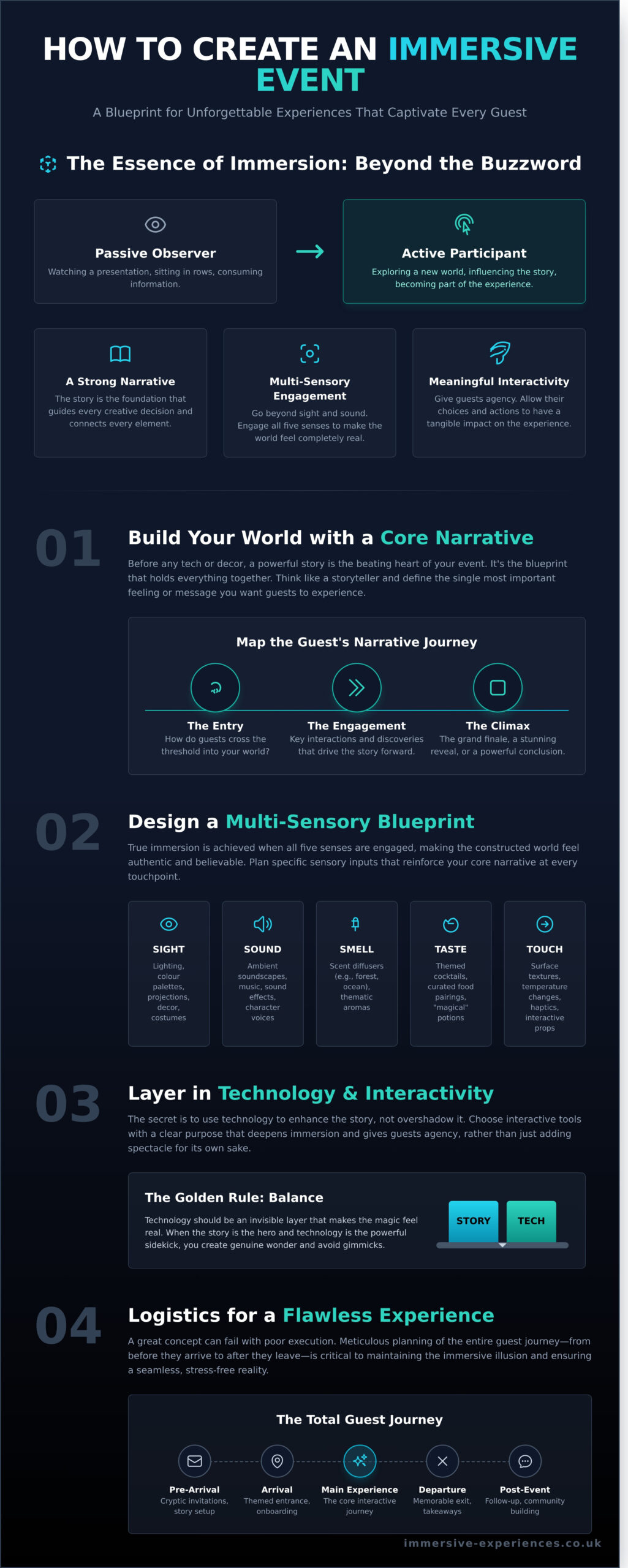
The word ‘immersive’ is everywhere, but what does it truly mean? It’s more than just a buzzword for an event with flashy tech. True immersion is a magical transformation. It’s the art of moving your guests from being passive observers into active participants within a new reality. The goal is to build a believable, captivating world that engages the senses and emotions so completely that the outside world melts away. Drawing from the core principles of immersive theatre, where the audience is part of the story, the aim is to forge a powerful emotional connection, not just to present information.
Imagine the difference: a traditional conference involves sitting in rows, watching a presentation. An immersive brand activation, however, invites you to explore a fantasy landscape, interact with characters, and influence the narrative. This is the fundamental secret of how to create an immersive event. It all boils down to three incredible, core elements:
- A Strong Narrative: Every captivating world needs a story. This is the thread that connects every interaction and element.
- Multi-Sensory Engagement: Go beyond sight and sound. What can guests touch, taste, and smell to make the world feel real?
- Meaningful Interactivity: Give your audience agency. Allow their choices and actions to have a tangible impact on their experience.
The Psychology of Immersion
At its heart, immersion is about creating a psychological state of ‘flow,’ where attendees become so absorbed they lose track of time. This is achieved by triggering genuine emotional responses through powerful storytelling and atmospheric design. By crafting an experience that feels personal and unique to each guest, you create stunning, unforgettable moments that resonate long after the event has ended.
Passive vs. Active Participation
The distinction is simple but profound. Passive participation is watching a keynote on a screen. Active participation is stepping through a portal, solving a puzzle to unlock the next part of a story, or co-creating a piece of art. When guests become active agents in the experience, their engagement skyrockets. This active role doesn’t just make the event more fun-it leads to dramatically higher brand recall and a deeper, more meaningful connection to your message.
Step 1: Build Your World with a Core Narrative
Before a single light is hung or a prop is placed, the most powerful immersive events begin with a story. This core narrative is the beating heart of your experience-the foundational blueprint that holds every other element together. The first secret to understanding how to create an immersive event is to move beyond logistics and think like a storyteller. Start by asking ‘why’: what is the single most important feeling, idea, or message you want your guests to walk away with?
Your narrative must resonate deeply with your audience. Consider who they are and what worlds they dream of exploring—a principle that applies to both events and real-world travel, where companies like Mireabilis build entire holidays around a story of authentic immersion; for help uncovering these kinds of deep audience insights for your own brand, visit Human Instinct. A well-crafted story provides a clear arc for the experience, giving the journey a beginning, a middle, and a memorable end. This narrative becomes the essential guide you use to design immersive experiences and environments where every detail, from the first invitation to the final farewell, reinforces the world you’ve built.
Choosing a Powerful Theme
Your theme is the tangible expression of your narrative. Brainstorm concepts that amplify your event’s goals and align with your brand’s personality. Will you launch a new product in a stunning, future-forward metropolis? Or perhaps invite guests to unravel secrets in a mysterious enchanted forest? Imagine transporting them millions of years into the past with a thrilling hands-on dinosaur adventure, creating a truly unforgettable journey.
Mapping the Guest Journey
A powerful story unfolds sequentially. Meticulously plan the path your guests will take to ensure a seamless and captivating experience. Think about their journey in distinct phases:
- The Entry: How do guests cross the threshold into your world? This could be a time-traveling portal, a cryptic message that grants access, or a dramatically themed entrance that immediately shifts their perception.
- The Engagement: What are the key moments, interactions, and discoveries that will drive the narrative forward? Plan for pivotal scenes, hands-on activities, or encounters with characters.
- The Climax & Conclusion: How does the experience end? A grand finale, a stunning reveal, or a quiet, reflective moment can all provide a powerful conclusion that leaves a lasting emotional impact.
Integrating Your Brand Story
The most masterful immersive events weave the brand message into the very fabric of the story, allowing for organic discovery. Instead of overt sales pitches that shatter the illusion, let your brand’s values be demonstrated through the experience itself. If your brand stands for innovation, let guests interact with groundbreaking technology. If it’s about connection, design moments that encourage collaboration. Let them live your brand story, not just hear it.
Step 2: Design a Multi-Sensory Blueprint
True immersion is a full-body experience. While stunning visuals and powerful audio are foundational, the most memorable events are those that engage all five senses to build a rich, believable world. Understanding how to create an immersive event begins with moving beyond the obvious. A detailed sensory blueprint is your master plan for orchestrating a cohesive atmosphere where every small detail, from a subtle scent to a specific texture, contributes to a powerful and unforgettable feeling.
Sight: Visuals and Environment
Your visual landscape is the primary canvas for your story. Use dynamic lighting, a deliberate colour palette, and dazzling projections to completely transform a space. For the ultimate visual impact, a unique venue like a premium geodesic dome offers a breathtaking 360° canvas for fulldome shows or environmental projections. Every visual element, from large-scale decor and props to the details on staff costumes, must be in perfect alignment with your theme.
Sound: Music and Soundscapes
Sound is the invisible architecture of your event’s atmosphere. Go beyond a simple playlist and design a custom soundscape that evolves with the guest’s journey. Use ambient sounds-the distant chatter of a fantasy marketplace or the gentle rustle of leaves in an enchanted forest-to make the environment feel truly alive. For a truly next-level experience, consider using directional audio to guide attention, create surprising moments, or deliver narrative cues to individuals as they explore.
Touch, Smell, and Taste
The final, magical layers of immersion are often the most overlooked. These tangible senses ground your guests in the reality you’ve built, making the experience deeply personal. This holistic approach is the secret to how you create an immersive event that resonates long after it’s over.
- Touch: Incorporate varied textures on surfaces, interactive objects that invite physical contact, and even subtle temperature changes to match the environment (e.g., a cool mist for a cavern).
- Smell: Use carefully chosen scents via diffusers to set a scene or evoke powerful memories. The scent of pine can transport guests to a forest, while the smell of old parchment can ground them in a historical library.
- Taste: Elevate your catering from simple refreshment to a core part of the narrative. Themed cocktails and culinary creations that reflect the story add a delicious and engaging dimension to the world.
Step 3: Layer in Technology and Interactivity
Once your narrative is set, technology becomes the magic wand that brings your world to life. The secret to how to create an immersive event that feels authentic is using technology to enhance the story, not eclipse it. The most effective tools are intuitive, serving a clear purpose that guides guests deeper into the experience without pulling them out of the moment. Interactivity is key; it gives your guests agency, transforming them from passive observers into active participants.
From simple, creatively themed photo booths to complex, multi-sensory installations, the right technology can be scaled to fit your vision and budget, ensuring every guest leaves with a story that feels uniquely their own.
Projection Mapping and 360° Video
Imagine turning any surface-from a historic building to an entire room-into a dynamic, storytelling canvas. That’s the power of projection mapping. For a truly collective, jaw-dropping moment, envelop your guests inside a projection dome, where they can share a journey through the cosmos or a deep-sea dive. Our incredible library of 360° fulldome shows offers a universe of possibilities for any theme.
Virtual and Augmented Reality (VR/AR)
VR and AR offer a direct portal into another reality. With VR, you can transport guests to impossible locations-the surface of Mars, a microscopic world, or a digital art gallery. Augmented Reality, on the other hand, masterfully overlays digital information onto the real world through a phone or headset. These powerful VR experiences are unparalleled tools for brand storytelling and creating unforgettable moments of discovery.
Gamification and Interactive Elements
Give your guests a role to play and make the story their own. Interactivity transforms passive attendance into active adventure. You can achieve this by incorporating:
- Challenges and Puzzles: Create digital scavenger hunts or collaborative problems that unlock the next part of the narrative.
- Interactive Displays: Use motion-sensing screens or responsive touch-screen surfaces that react to guests’ actions.
- Environmental Influence: Empower guests to change the lighting, soundscape, or on-screen visuals with their movements or choices.
By thoughtfully weaving in these elements, you don’t just show your guests a story-you invite them to live inside it, making the experience deeply personal and infinitely more memorable.
Step 4: Logistics and Execution for a Flawless Experience
A magical concept is just the beginning. The secret to how to create an immersive event that truly captivates lies in flawless execution. Every detail, from the moment a guest receives their invitation to the final follow-up email, must be a seamless extension of the world you’ve built. This is where the magic becomes real, transforming a great idea into an unforgettable, living experience. Meticulous planning of the guest journey and flow is essential to avoid bottlenecks and maintain the illusion from start to finish.
Choosing the Right Venue and Partners
Your venue is the canvas for your universe. Seek a space that can be utterly transformed to fit your narrative-often, a blank canvas venue offers more creative freedom than a pre-decorated one. Partnering with technical and creative experts, such as a dedicated corporate event production company UK, who understand the unique demands of immersive activations, from stunning projection mapping in a Geodesic Dome to bespoke soundscapes, is crucial. They provide the scaffolding upon which your incredible world is built.
Onboarding Your Team
Your team members are not just staff; they are inhabitants of your world. Brief everyone, from actors to technicians and hosts, on the core story and their specific role in maintaining the illusion. Simple touches like themed costumes and basic character coaching can make a monumental difference, transforming a standard event into a living, breathing experience. Every interaction should deepen the immersion, never break it.
Measuring Success and ROI
An amazing experience should also deliver amazing results. Before your event, define what success looks like. Your Key Performance Indicators (KPIs) will be unique to your goals, but common metrics for measuring the impact of your immersive event include:
- Social Media Engagement: Tracking mentions, branded hashtags, and user-generated content.
- Lead Generation & Sales: Measuring direct business impact and conversions from the event.
- Press & Media Coverage: Gauging the public relations value and reach.
- Attendee Sentiment: Using post-event surveys to capture direct feedback and Net Promoter Score (NPS).
Ultimately, understanding how to create an immersive event is about mastering the art of detail-oriented execution. By meticulously planning the guest journey, empowering your team, and measuring what matters, you can deliver a truly unforgettable activation that achieves your strategic goals.
Transform Your Vision into an Unforgettable Reality
You now have the blueprint. From building a core narrative that provides meaning to designing a multi-sensory experience that captivates your audience, the path is clear. Ultimately, knowing how to create an immersive event isn’t about a single gimmick; it’s about flawlessly orchestrating a complete sensory and emotional journey that transports your guests to another world entirely.
When you’re ready to bring that journey to life, you need a partner with proven expertise. As an award-winning global experiential provider, we’ve delivered over 1.2 million incredible engagements. With the world’s largest fleet of mobile planetariums and domes, we possess the scale and innovation to make your vision a stunning, magical reality.
Ready to create something unforgettable? Explore our immersive event solutions!
The only limit is your imagination. Let’s start building worlds together.
Frequently Asked Questions
How much does it cost to create an immersive event?
The cost is as vast as the universe of possibilities! A simple sensory installation might start in the low thousands, while a fully-realised, multi-day experience with custom technology and performers can scale into six figures or more. Key cost drivers include technology (like VR or projection mapping), venue customisation, talent, and the level of sensory detail you want to achieve. Every magical journey has a unique budget, and we create bespoke solutions to match.
How do you measure the ROI of an immersive or experiential event?
Measuring ROI is a key part of how to create an immersive event that succeeds. Go beyond ticket sales and track social media engagement via dedicated hashtags, audience sentiment with surveys, and media reach. For corporate activations, key metrics include lead generation, dwell time within the experience, and brand recall. We’ve seen over 1.2 million engagements, proving a stunning experience delivers quantifiable results that echo long after the event concludes.
Can you create an immersive experience for a small event or budget?
Absolutely! Creating an immersive experience isn’t just about grand-scale technology. You can craft a stunning world on a smaller budget by focusing on a powerful narrative, clever lighting, curated soundscapes, and tactile elements. Think themed scents, textured fabrics, and interactive storytelling with a single performer. The key is creativity and focusing all your resources on engaging a few senses deeply rather than trying to do everything at once. A universe of wonder can be built in a single room.
What is the difference between an ‘interactive’ and an ‘immersive’ event?
An interactive event invites you to do something-like touching a screen or voting in a poll. It’s a two-way street of action and reaction. An immersive event, however, transports you into a different reality. It builds a complete sensory world around you, making you feel like a part of the story, not just an observer. While many immersive events are interactive, an event can be interactive without being fully immersive. Immersion is about total environmental captivation.
How far in advance do I need to start planning an immersive event?
For a truly incredible immersive event, the journey should begin early. We recommend a minimum of 6-9 months for complex, large-scale experiences involving custom builds or advanced technology. For simpler activations or events using existing tech like our mobile planetarium domes, 3-4 months can be sufficient. This lead time ensures every magical detail is perfected, from technical logistics to narrative flow, guaranteeing a seamless and stunning experience for your guests.
What are some common mistakes to avoid when planning an immersive event?
A common pitfall is neglecting the narrative; amazing tech without a compelling story feels hollow. Another mistake is sensory overload-bombarding guests with too much stimulus can be confusing rather than captivating. Finally, avoid overlooking practicalities like guest flow and accessibility. The most magical experiences are built on a solid foundation of thoughtful planning, ensuring every guest can comfortably journey through the world you’ve built.