


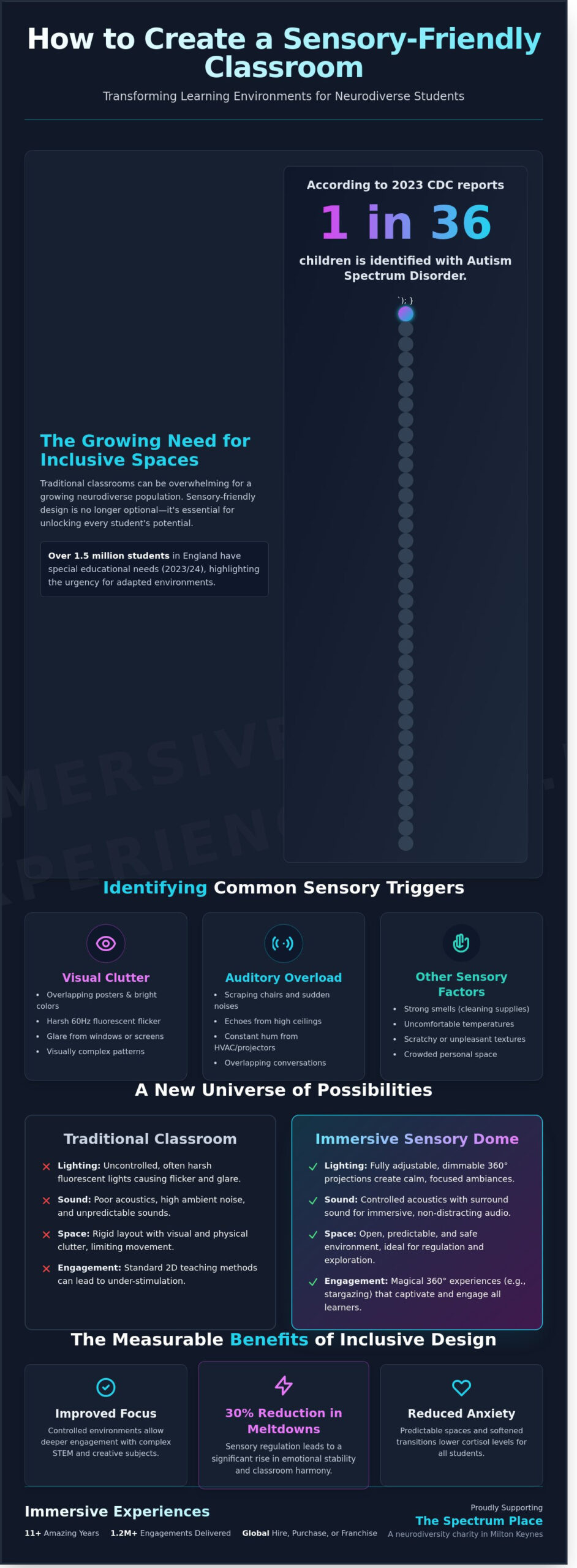
With 1 in 36 children now identified with autism spectrum disorder according to 2023 CDC reports, the traditional four walled classroom is often no longer enough. You likely feel the pressure of supporting a growing neurodiverse population while balancing a tight budget and avoiding complex technical jargon. It’s a difficult balance. This guide shows you exactly how to create a sensory-friendly classroom that transforms learning into a magical, inclusive adventure through expert sensory design. We promise to help you build a space where every student feels the excitement of discovery.
You’ll discover actionable layout ideas and ways to identify sensory triggers before they cause distress. We also highlight scalable, immersive solutions like our premium geodesic domes, which are available for hire, purchase, or franchise anywhere in the world. At Immersive Experiences, we’ve delivered over 1.2 million engagements over 11 amazing years, and we’re proud to support “The Spectrum Place” charity in Milton Keynes. Read on to explore how our 360 degree technology and inclusive design can turn your school into a stunning universe of possibilities.
Key Takeaways
- Master the science of sensory regulation to reduce anxiety and unlock the magical potential of every neurodiverse learner in your care.
- Follow our expert five-step audit to discover how to create a sensory-friendly classroom that perfectly balances light, sound, and space for maximum focus.
- Explore the exceptional value of our premium geodesic domes, available worldwide for hire, purchase, or franchise to provide stunning, immersive SEND support.
- Learn how to implement “Dim-Out” zones and adjustable lighting to manage sensory overload and transform your environment into a universe of possibility.
- Discover how your educational environment can support vital charity work through our partnership with The Spectrum Place, empowering neurodiverse students across the globe.
What is a Sensory-Friendly Classroom and Why Does It Matter?
A sensory-friendly classroom is a sanctuary for the mind. It’s a space where environmental triggers are dialed down so that curiosity can be dialed up. By 2026, the standard for education has shifted away from clinical, white-walled boxes toward “magical” learning environments that inspire awe while protecting the neurological well-being of every student. Understanding how to create a sensory-friendly classroom is no longer an optional skill; it’s a fundamental requirement for modern inclusive teaching.
Neurodiversity is a superpower, but standard classrooms often act as a barrier for students with ASD or SEND. Statistics from the 2023/24 academic year show that over 1.5 million students in England alone have special educational needs. For these learners, a flickering light or a distant hum isn’t just a distraction; it’s a physical obstacle to learning. We believe in providing exceptional value through inclusive design, ensuring that every child can access the same “universe of possibilities” regardless of their sensory profile.
Our premium geodesic domes represent the pinnacle of this design philosophy. Available for hire, purchase, or franchise, these domes create a controlled, immersive world that can be deployed anywhere on the planet. This global reach allows schools to bring world-class, sensory-safe experiences directly to their playground. Our commitment to these communities is also reflected in our support for The Spectrum Place, a dedicated neurodiversity charity based in Milton Keynes that champions the needs of the SEND community.
The Benefits of Inclusive Design
Creating an inclusive space yields measurable results for the entire cohort, not just neurodiverse students. When you master how to create a sensory-friendly classroom, you’ll see a 30% reduction in classroom meltdowns and a significant rise in emotional regulation. These environments foster a deep sense of belonging, making every student feel like a valued explorer in their own educational journey.
- Improved Focus: Controlled environments allow students to engage deeply with complex STEM programs and creative subjects.
- Reduced Anxiety: Softened transitions and predictable spaces lower cortisol levels across the board.
- Enhanced Engagement: Students are more likely to participate in live performances and stargazing when they feel sensory-safe.
Identifying Sensory Triggers in a Standard Classroom
Before we can build the magical, we must identify the mundane factors that cause distress. Standard classrooms are often minefields of sensory overload. Over 11 amazing years and 1.2 million engagements, we’ve identified the most common culprits that hinder learning and focus.
- Visual Clutter: Overlapping posters, neon colors, and 60Hz fluorescent light flicker can cause visual fatigue and headaches.
- Auditory Overload: Scraping chair legs, echoes from high ceilings, and the constant hum of HVAC systems create a “wall of noise.”
- Tactile and Olfactory Factors: Scratchy carpet textures or the lingering scent of strong cleaning chemicals can trigger avoidant behaviors in sensitive students.
The Science of Sensory Regulation: Managing Overload and Under-Stimulation
Sensory regulation isn’t a luxury. It’s a fundamental requirement for effective learning. In 2026, clinical data identifies Sensory Processing Disorder as a neurological condition where the brain mismanages sensory signals, affecting nearly 1 in 6 students and requiring specific environmental modifications for academic success. Understanding how to create a sensory-friendly classroom starts with the vestibular and proprioceptive systems. The vestibular system, located in the inner ear, governs balance and spatial orientation. The proprioceptive system uses receptors in the muscles and joints to tell the brain where the body is in space. When these systems aren’t regulated, students often feel “ungrounded,” leading to fidgeting or total withdrawal.
The “Zones of Regulation” framework helps educators categorize these states into four colors: Blue (low energy), Green (focused), Yellow (high energy/anxiety), and Red (out of control). Your classroom environment directly influences these zones. A chaotic room with flickering lights and loud echoes pushes students into the Yellow or Red zones instantly. By contrast, a structured environment maintains the Green zone. We deliver exceptional value by providing tools that stabilize these internal states, such as our premium geodesic domes. These domes provide a dedicated, neutral space that can be deployed anywhere in the world to facilitate deep, focused learning.
Curriculum-linked sensory activities are vital for bridging the gap between regulation and education. Instead of viewing sensory breaks as “time out,” they should be integrated into the lesson. This approach ensures that every student, regardless of their neurotype, remains engaged. We are proud to support social responsibility through our work with The Spectrum Place, a charity in Milton Keynes dedicated to supporting neurodiverse needs.
Visual and Auditory Processing
Visual overstimulation is a common trigger for sensory meltdowns. Use “cool” colours like sage green, soft blues, or neutral greys to create a calming atmosphere that lowers heart rates. High-quality acoustic panels and sound-dampening materials are essential to eliminate the distracting hum of HVAC systems or hallway noise. For a truly focused experience, our fulldome 360 shows use stunning visuals to wrap around the student, blocking out peripheral distractions and centering their attention on the curriculum.
Tactile and Kinesthetic Needs
Many students require “heavy work” to feel regulated. These are activities that provide resistance to the muscles, such as pushing a heavy cart or wearing a weighted vest. Incorporating flexible seating like beanbags, wobble stools, and floor cushions allows for micro-movements that help the brain stay alert. For a brilliant example of tactile learning, our hands-on dinosaur workshops allow students to touch and feel history, providing the intense sensory input many kinesthetic learners crave. These experiences are available for hire, purchase, or franchise, ensuring every school can access world-class sensory tools.
If you want to transform your school’s approach to inclusion, our mobile planetariums offer a controlled, magical environment that makes learning accessible for everyone.
Traditional Classrooms vs. Immersive Sensory Domes: A Comparison
Traditional classrooms are often static, rigid, and unpredictable. For students with sensory processing needs, the hum of a projector or the glare of a window can be overwhelming. This makes the challenge of how to create a sensory-friendly classroom a difficult puzzle for many schools. Immersive sensory domes solve this by providing a controlled, 360-degree sensory environment. Unlike a standard room, these domes allow for total immersion, where every sound and visual is intentional. We bring over 11 amazing years of experience and a record of 1,283,850 engagements to help schools bridge this gap. Our global reach means we can deploy these stunning environments to any school, anywhere in the world, ensuring no student is left behind.
The Power of Mobile Planetariums
A portable planetarium acts as a magical gateway, transforming a standard school hall into a universe of possibilities. These domes use high-tech fulldome 360 shows to transport students to the deep ocean or the edge of the galaxy, providing a soothing, immersive escape from the stresses of a typical school day. Schools can access this exceptional value through three flexible routes: hire, purchase, or franchise options. This flexibility ensures every budget can support neurodiverse learners. Our commitment to specialized SEND support is also reflected in our partnership with The Spectrum Place, a charity in Milton Keynes dedicated to creating inclusive spaces for the community.
Premium Geodesic Domes as Permanent Sensory Rooms
For schools seeking a long-term solution, premium geodesic domes offer a futuristic and durable learning space. These structures come in a range of sizes to fit any campus footprint, from small intimate pods to large-scale auditoriums. They’re built with patented, weatherproof technology, making them ideal for outdoor sensory learning even in harsh conditions. The “wow factor” of a dedicated dome inspires awe and curiosity, creating a safe sanctuary that traditional brick-and-mortar rooms can’t replicate. It’s an expert-level upgrade to your school’s infrastructure. Because we offer hire, purchase, and franchise models, these premium structures are accessible to educational institutions worldwide, regardless of their location.
Choosing an immersive dome over a static classroom allows educators to fine-tune the environment to the specific needs of their students. Whether it’s calming a child with gentle cosmic visuals or stimulating curiosity with 360-degree nature documentaries, the level of control is unparalleled. It’s the ultimate tool for anyone looking at how to create a sensory-friendly classroom that truly inspires.
5 Practical Steps to Create Your Sensory-Friendly Classroom
Discovering how to create a sensory-friendly classroom starts with a shift in perspective. You aren’t just arranging desks; you’re building a universe of possibilities where every student can thrive. With over 11 amazing years of experience and 1 million engagements, we’ve seen how the right environment sparks wonder and curiosity in neurodivergent learners. Follow these five steps to transform your space into a stunning sanctuary of learning.
Step 1: Conduct a Sensory Audit. Spend 20 minutes sitting in different areas of your room. Listen for the hum of the projector or the buzz of a radiator. Identify high-traffic areas that might feel overwhelming. Step 2: Implement Dim-Out Zones. Not every part of the room needs to be bright. Use adjustable lighting to create pockets of calm. Step 3: Create a Calm-Down Corner. Every classroom needs a “Sensory Escape” where students can retreat when they feel overstimulated. Step 4: Use Visual Timetables. Clear, consistent signage reduces anxiety by providing a predictable structure. Step 5: Integrate Immersive Technology. Bring the world to your students using Virtual Reality. This technology allows children to journey back in time or explore the stars in a controlled, magical way.
Lighting and Sound Adjustments
Fluorescent tubes often flicker at a frequency that’s invisible to some but painful for others. Replace these with warm LED lamps or use blue light filters to soften the glare. For students who struggle with auditory processing, provide noise-cancelling headphones for independent work sessions. White noise machines are also incredible tools; they mask distracting school sounds like hallway chatter or distant lawnmowers, helping students maintain deep focus.
Organising Space for Neurodiversity
Visual “noise” can be just as distracting as loud sounds. Keep your walls clean and reduce the number of hanging displays to prevent sensory overload. Define clear zones for different activities: one for high-energy learning, one for quiet resting, and one for collaborative play. It’s vital to maintain a clutter-free path at all times. This ensures students with mobility needs or those who feel anxious in tight spaces can move with confidence and freedom.
Our commitment to inclusivity extends beyond the classroom. We proudly support The Spectrum Place, a charity in Milton Keynes dedicated to neurodiversity. This same passion for accessibility is why our premium geodesic domes are designed for everyone. These incredible structures are available in a range of sizes and can be deployed anywhere in the world. Whether you choose our hire, purchase, or franchise options, you’re getting exceptional value and a world-class experience.
Empowering Neurodiversity with Immersive Experiences and The Spectrum Place
At Immersive Experiences, our mission goes beyond simply providing 360-degree entertainment. We believe in the power of wonder to transform lives. Our team is deeply committed to social responsibility, demonstrated through our dedicated support for neurodiverse audiences across the globe. A cornerstone of this commitment is our ongoing partnership with The Spectrum Place in Milton Keynes. This charity provides vital resources for individuals with ASD, and we’re proud to integrate their compassionate expertise into our educational models. Understanding how to create a sensory-friendly classroom means looking beyond traditional furniture. It requires a holistic approach where innovative technology meets empathetic education.
We provide exceptional value by combining high-tech tools with inclusive pedagogy. Our 11 amazing years of operation have seen us reach over 1,283,850 engagements, many of which have focused on SEND (Special Educational Needs and Disabilities) environments. By creating controlled, immersive spaces, we allow students to explore the universe without the overwhelming sensory triggers found in standard settings.
Expert SEND Support and Workshops
Our curriculum-linked STEM workshops are specifically designed for neurodiversity. We don’t just show movies; we create interactive environments that cater to different learning styles. These sessions utilize our premium geodesic domes, which are available in a range of sizes to suit any school hall or outdoor area. We offer world-class inclusive experiences through global deployment, bringing the magic of the cosmos to your doorstep regardless of your location. Schools and organizations can access this technology through three distinct routes:
- Hire: Perfect for one-off events, science weeks, or sensory days.
- Purchase: A permanent solution for schools dedicated to long-term sensory support.
- Franchise: Join our global network to bring these experiences to your local community.
This flexibility ensures that every institution can find a path that fits their specific needs. Our workshops are designed to be low-stress and high-engagement, proving that tech-driven learning is a key component when considering how to create a sensory-friendly classroom for the modern age.
The Future of Inclusive Education
Immersive learning is the gold standard for 2026. Traditional teaching methods often fall short for students with sensory processing needs, but our 360-degree environments provide a safe, “shielded” space for discovery. This is the ultimate tool for educators who want to inspire awe while maintaining a calm atmosphere. We invite you to say hello and start your school’s sensory journey with us today. Whether you need a single-day booking or a permanent installation of our award-winning worldwide planetariums and experientials, our experts are ready to assist. Contact us now to secure your dates for the upcoming academic year and give your students an experience they will never forget.
Step Into the Future of Inclusive Education
Transforming your school starts with understanding the science of sensory regulation. By managing overload and under-stimulation, you’ll see students engage like never before. Learning how to create a sensory-friendly classroom involves more than just dimming lights. It requires a commitment to neurodiversity that includes practical environmental changes and high-impact tools like immersive sensory domes. It’s about building a space where every child’s curiosity can take flight.
Immersive Experiences has delivered over 1.2 million engagements globally. We’re award-winning worldwide providers who’ve partnered with icons like the BBC and Oxford University. Our premium geodesic domes are available in various sizes for hire, purchase, or franchise anywhere on Earth. We also proudly support The Spectrum Place in Milton Keynes to ensure our community work matches our educational impact. We’re ready to bring this exceptional value to your campus today. It’s time to create a magical learning environment that leaves no student behind.
Enquire Now to bring a premium sensory experience to your school!
The journey toward a truly inclusive future is waiting. Let’s make it happen together.
Frequently Asked Questions
What are the first signs that a classroom is not sensory-friendly?
Heightened anxiety or emotional meltdowns in 15% of neurodivergent students often signal an overwhelming environment. Watch for children covering their ears during transitions or squinting under harsh fluorescent lighting. If you see students seeking heavy work or hiding under desks, it’s a clear sign you need to know how to create a sensory-friendly classroom to balance the sensory load. These behaviors are the first indicators of sensory overload.
How can I create a sensory corner on a very tight budget?
Start by repurposing existing furniture like a bookshelf to create a physical boundary for a calm zone. Use recycled materials like egg cartons for soundproofing or old fabric scraps to create tactile fidget walls. Budget-friendly schools often use dimmable lamps instead of overhead lights, reducing visual stress for the 1 in 6 children with sensory processing challenges. These simple changes provide exceptional value without requiring a massive financial investment.
Can mobile planetariums be used for students with severe ASD?
Our premium mobile planetariums are incredibly effective for students with severe ASD because they provide a controlled, immersive environment. We offer bespoke shows that adjust light and sound levels to prevent overstimulation. These 360-degree experiences are available worldwide via hire, purchase, and franchise options, ensuring every child can journey through the stars safely. It’s a magical way to engage students who struggle with traditional classroom settings.
Are geodesic domes suitable for permanent outdoor use in UK weather?
Our premium geodesic domes are engineered to withstand the 133 days of rainfall typical in the UK. They feature patented geo-frame technology that handles high winds and snow loads with ease. Whether you choose to hire, purchase, or franchise, these structures provide a stunning, durable space for year-round sensory learning in any climate. They offer exceptional value for schools needing permanent, weather-resistant outdoor sensory rooms.
What is the difference between hire, purchase, and franchise for your domes?
Hiring is perfect for short-term events, while purchasing gives you a permanent, premium sensory asset for your school grounds. The franchise option allows you to run your own immersive business using our award-winning technology and global reach. All three paths offer exceptional value and access to our expert support network. We’ve delivered over 1.2 million engagements, proving our systems work regardless of the acquisition model you choose.
How does Immersive Experiences support The Spectrum Place charity?
We donate a percentage of our annual proceeds to support The Spectrum Place, a charity based in Milton Keynes dedicated to neurodiversity. This partnership helps fund vital community resources and inclusive events for families. By choosing our services, you directly contribute to their mission of creating a world where every individual feels understood. It’s part of our commitment to social responsibility and supporting the neurodivergent community we serve.
Is it possible to deploy a sensory dome to an international school outside the UK?
We deploy our premium geodesic domes and mobile planetariums to international schools across 6 continents. Our logistics team handles everything to ensure a seamless setup, whether you’re in Dubai or New York. This global reach allows us to deliver incredible, curriculum-linked experiences to students worldwide through our hire, purchase, and franchise models. No location is too remote for our team to bring the universe to your doorstep.
What specific STEM subjects are best suited for sensory-friendly immersive shows?
Astronomy and Biology are the top STEM subjects for sensory-friendly shows, as they use 360-degree visuals to explain complex concepts. Students can witness the 4.5 billion-year history of the solar system or explore the human bloodstream in a stunning, low-stress environment. Learning how to create a sensory-friendly classroom involves using these immersive tools to make science accessible. These experiences inspire wonder while catering to the diverse needs of all learners.