


Ever stared into the sky and felt a sense of wonder, quickly followed by a feeling of being… small? The sheer scale of the universe can be overwhelming, with numbers so vast they feel almost meaningless. It’s a common question with a profoundly difficult answer: just how big is the sun? Too often, the explanation is a dizzying string of zeros and dry scientific terms that fail to capture the star’s true magnificence.
Forget the complicated textbooks. This is your guide to our star’s epic scale, reimagined. We’re on a mission to transform those abstract figures into something you can truly feel and visualize. We’ll journey through stunning, simple comparisons that will stick in your mind, helping you grasp the colossal size of the fiery heart of our solar system in a way that feels both magical and real.
Prepare to have your perspective completely shifted. By the end of this incredible exploration, you won’t just have an answer; you’ll have a newfound sense of awe for our place in the cosmos. Let’s begin!
The Sun by the Numbers: Getting a Sense of Scale
So, just how big is the sun? In short: it’s mind-bogglingly, colossally enormous. With a diameter of approximately 1.4 million kilometers (865,000 miles), our star is a true giant. But numbers alone can feel abstract. To truly grasp its scale, we need to dive into some incredible comparisons that bring these cosmic figures down to Earth.
These statistics provide a glimpse into the sheer power and size of the star at the center of our solar system. They are the foundation for understanding its incredible influence on every planet, including our own.
| Key Statistic | Measurement |
| Diameter | 1.4 million km (865,000 miles) |
| Mass | 333,000 times the mass of Earth |
| Volume | 1.3 million Earths could fit inside |
| Surface Temperature | Approx. 5,500°C (9,940°F) |
Diameter and Radius: Measuring Our Star
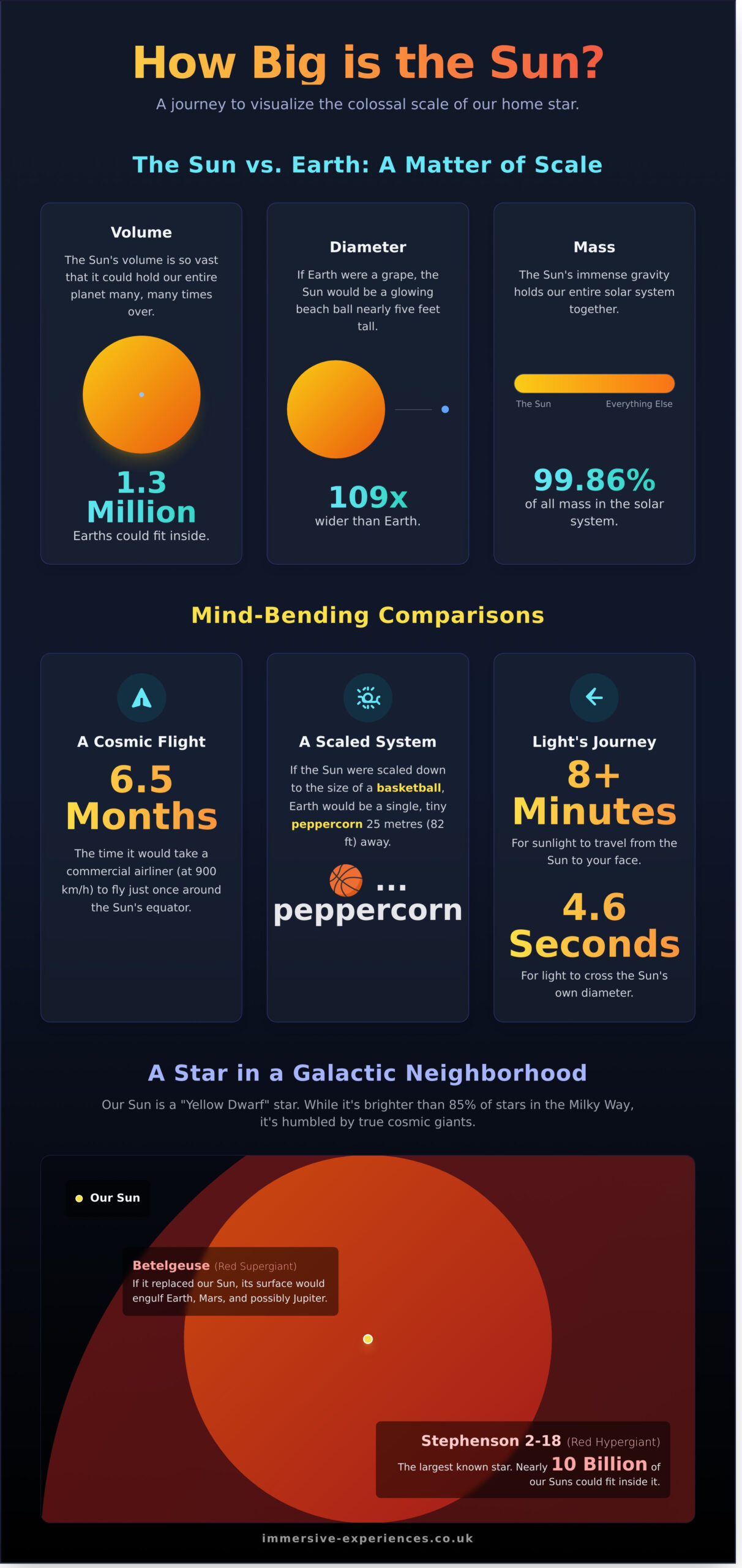
The Sun’s diameter is about 109 times wider than Earth’s. To put that into a stunning perspective, imagine our planet Earth is the size of a small grape. At that scale, the Sun would be a gigantic, glowing beach ball nearly five feet tall! This simple comparison begins to paint a picture of its immense size.
Volume: How Many Earths Could Fit Inside?
This is where the question of “how big is the sun” becomes truly awe-inspiring. The Sun’s volume is so vast that you could fit approximately 1.3 million Earths inside it. Picture a vast stadium, and now imagine filling it to the very top with tennis balls. That’s the relationship between the Sun and our world-a staggering difference that showcases its cosmic dominance.
Mass: The True Heavyweight of the Solar System
While its volume is immense, the Sun’s mass is even more dominant. It is 333,000 times more massive than Earth. This incredible figure is a cornerstone of understanding the Sun’s epic scale, as it dictates the orbits of every planet. In fact, the Sun contains an unbelievable 99.86% of all the mass in our entire solar system. Everything else-all the planets, moons, asteroids, and comets combined-makes up a tiny 0.14%.
Visualising the Immensity: Mind-Bending Comparisons
The numbers are staggering, but what do they truly mean? To comprehend the sheer scale of our star and answer the question of how big is the sun, we need to embark on a journey of the imagination. Let’s translate these colossal figures into incredible, mind-bending comparisons that bring its vastness into sharp focus.
A Flight Around the Sun
Imagine boarding a commercial airliner for the ultimate round-the-world trip-not around Earth, but around the Sun’s equator. Buckle up for an epic journey. Flying non-stop at a typical cruising speed of 900 km/h (560 mph), this incredible voyage would take you over six and a half months to complete! For perspective, the same flight around Earth’s equator would be over in less than two days. It’s a journey that redefines long-haul travel on a cosmic scale.
Scaling Down the Solar System
Let’s shrink the cosmos to a more manageable size in this classic thought experiment. If we were to scale the Sun down to the size of a standard basketball, what would our home planet look like? Earth would be no more than a single, tiny peppercorn, located about 25 metres (82 feet) away. And Jupiter, the undisputed king of the planets? It would be a large marble. This simple model powerfully illustrates the Sun’s absolute dominance in our solar system.
Light’s Journey: The Ultimate Speed Limit
Nothing in the universe moves faster than light, yet even at this ultimate speed limit, the Sun’s size is immense. The sunlight warming your face right now began its journey over eight minutes ago. But perhaps more astonishing is the time it takes for a photon of light to travel across the Sun’s own diameter. According to data in NASA’s guide to the Sun, that journey takes a full 4.6 seconds. Even at 299,792 kilometres per second, crossing our star is not instantaneous-a final, stunning testament to just how big the Sun truly is.
Our Sun in the Galactic Neighbourhood: A Cosmic Perspective
We’ve established our Sun’s colossal size relative to Earth. But to truly grasp the answer to how big is the sun, we must journey beyond our solar system into the vast, glittering expanse of the Milky Way. Here, among billions of other stars, our Sun finds its true place-not as a dominant giant, but as a humble, average citizen of a cosmic metropolis.
An Average Star: The Yellow Dwarf
Astronomers classify our home star as a G-type main-sequence star, more commonly known as a yellow dwarf. While this might sound modest, our Sun is actually brighter and more massive than about 85% of the other stars in our galaxy! According to detailed data like that found in NASA’s Guide to the Sun, it perfectly balances size and stability to support life. However, in the grand cosmic theatre, the remaining 15% includes stars so enormous they challenge the very limits of imagination.
Meeting the Giants: Betelgeuse and Antares
Prepare to recalibrate your sense of scale. Meet the red supergiants-stellar titans like Betelgeuse and Antares that are in the late stages of their spectacular lives. To put their incredible size into perspective, imagine for a moment replacing our Sun with Betelgeuse. Its fiery surface wouldn’t just touch Earth; it would completely engulf the orbits of Mercury, Venus, Earth, and Mars, possibly even reaching Jupiter. Our entire inner solar system would exist inside this single, breathtaking star.
The Hypergiants: Stephenson 2-18, The Record Holder
If red supergiants are giants, then hypergiants are the gods of the stellar world. The current record-holder for the largest known star is Stephenson 2-18, a red hypergiant of almost unbelievable proportions. With a radius estimated to be over 2,000 times that of our Sun, its sheer volume is staggering. It’s so vast that nearly 10 billion of our Suns could comfortably fit inside it. The question of how big is the sun suddenly feels very different when faced with a cosmic monster like this. The story of this star is an astronomical adventure all on its own.
Why the Sun’s Size is Crucial for Life on Earth
The mind-boggling scale of the Sun isn’t just an astronomical fun fact; it is the fundamental reason we exist. Its immense size directly dictates the conditions in our solar system, creating a stable and energy-rich environment perfect for life to flourish. When we ask how big is the sun, we are also asking why Earth is a living, breathing world. The answer lies in a magical interplay of mass, gravity, and raw power.
The Power of Gravity: The Solar System’s Anchor
The Sun’s staggering mass, accounting for 99.8% of all mass in the solar system, generates an incredible gravitational pull. This force is the celestial anchor that holds everything, from the colossal Jupiter to the smallest asteroid, in a predictable cosmic ballet. Without the Sun’s specific size and mass, the planets would wander aimlessly through the cold emptiness of space. Our solar system simply wouldn’t exist as the orderly home we know.
A Giant Nuclear Engine: Fuelling Our World
The Sun’s sheer size creates titanic pressure and heat at its core-reaching an astonishing 15 million degrees Celsius. This intense environment is the ultimate cosmic furnace, forcing hydrogen atoms to fuse together to create helium. This process, known as nuclear fusion, unleashes the vast, life-giving energy that travels 93 million miles to Earth, powering our weather, our oceans, and every living thing on the planet.
Defining the ‘Goldilocks Zone’
The energy output from this giant nuclear engine defines the “habitable zone,” a region of space where conditions are just right for liquid water to exist on a planet’s surface. The Sun’s size and temperature are perfectly balanced for Earth:
- A larger, hotter star would have pushed the habitable zone further out, leaving Earth a scorched, lifeless rock.
- A smaller, cooler star would have pulled the zone closer in, turning our world into a frozen wasteland.
Our Sun’s size is the reason Earth resides in this perfect “Goldilocks Zone,” making it the cradle of life. To journey through this incredible cosmic neighbourhood and see these principles in action, explore the stunning 360-degree shows from Immersive Experiences.
Experience the Cosmos: Bring the Stars Down to Earth
Reading about the vastness of space is one thing, but truly comprehending it is another journey entirely. After exploring how big the sun is through facts and figures, you might feel a new sense of wonder and a curiosity to experience that scale firsthand. The numbers are mind-boggling, but they are just the beginning. It’s time to stop imagining the universe and start experiencing it.
Beyond the Page: Visualising Space in a Planetarium
Numbers on a screen can only take you so far. To truly feel the grandeur of our star, you need to see it. Our state-of-the-art mobile planetariums transport you from your location into the heart of the cosmos. Imagine leaning back as the universe unfolds around you in a stunning, fulldome 360° show. This immersive environment makes understanding just how big the sun is an intuitive, unforgettable experience, perfect for inspiring students and dazzling event guests.
An Unforgettable Journey for Your School or Event
This isn’t just a lesson; it’s a core memory in the making. Our award-winning shows blend breathtaking entertainment with curriculum-linked education, bringing the wonders of the Sun and distant galaxies directly to your school hall, festival, or corporate event. We create a shared moment of awe that sparks conversation and can ignite a lifelong passion for science and discovery. It’s an adventure that your audience will talk about for years to come.
Ready for an Adventure?
Your cosmic journey doesn’t have to end here. Transform abstract concepts into a tangible, magical reality and give your audience an experience they will never forget. Are you ready to bring the stars down to Earth?
Discover our incredible mobile planetarium shows today!
Bringing Our Star’s Immensity Down to Earth
From the staggering fact that 1.3 million Earths could fit inside it to its crucial role in creating a habitable zone for our planet, understanding how big is the sun is to truly grasp our own place in the cosmos. Its epic scale, while making it the undisputed heart of our solar system, also reveals it as just one of countless stars in the vast Milky Way. These numbers and comparisons paint a stunning picture, but they are only the beginning of a much grander story.
Reading about these cosmic scales is one thing; experiencing them is another. Ready to journey beyond the page and into the stars? Join over one million fellow explorers and witness the universe with our AWARD-WINNING WORLDWIDE PLANETARIUMS. Trusted by experts at NASA, the BBC, and National Geographic, we bring the wonders of space directly to you. Discover our awe-inspiring mobile planetarium experiences!
The universe is waiting to be explored. Your incredible adventure starts now.
Frequently Asked Questions About the Sun’s Immense Size
Is the Sun the biggest star in the universe?
While our Sun is the magnificent heart of our solar system, it’s far from the biggest star in the universe. It’s classified as a yellow dwarf, a fairly average star. True cosmic titans, known as hypergiants like UY Scuti, are so colossal they could contain billions of our Suns. Discovering these giants reveals the truly mind-boggling scale of the cosmos, a universe of stunning possibilities that we are only just beginning to explore.
How many Earths can fit inside the Sun?
Prepare to be amazed! The Sun’s incredible volume is large enough to hold approximately 1.3 million Earths. To truly grasp how big is the sun, imagine our planet as a tiny marble. You would need over a million of those marbles to fill a sphere the size of our star. This stunning comparison showcases the sheer power and grand scale of the celestial engine that fuels our entire solar system. It’s an astronomical fact that never fails to inspire awe.
Will the Sun get bigger in the future?
Yes, our Sun is on an epic, long-term journey of transformation. In about 5 billion years, it will exhaust the hydrogen fuel in its core and begin to swell dramatically, becoming a red giant. This future version of the Sun will be so enormous that it will expand past the orbits of Mercury, Venus, and possibly even Earth. This incredible stellar evolution is a powerful reminder of the dynamic and ever-changing nature of our universe.
What is the Sun made of?
The Sun’s magical recipe is surprisingly simple, yet incredibly powerful. It is a gigantic, glowing ball of superheated gas, technically a state of matter called plasma. This cosmic furnace is composed almost entirely of two elements: about 74% hydrogen and 24% helium. The remaining tiny fraction includes a mix of heavier elements like oxygen, carbon, and iron, all forged in the star’s fiery core through the process of nuclear fusion.
How far away is the Sun from Earth?
The Sun is an immense cosmic distance from our planet, a gap that defines our place in the solar system. On average, it lies about 93 million miles (150 million kilometers) away from Earth. This distance is so vast that it takes sunlight approximately 8 minutes and 20 seconds to make the incredible journey to reach us. This unit of distance is so fundamental to astronomy that it’s known as one Astronomical Unit (AU).
Could a human ever travel to the Sun?
While we dream of epic adventures to the stars, a journey to the Sun’s surface is beyond the realm of possibility. The challenges are simply unimaginable. The intense heat, reaching millions of degrees, and the overwhelming radiation would vaporize any spacecraft long before it got close. However, specialized probes like NASA’s Parker Solar Probe are our robotic explorers, bravely venturing near the Sun to unlock its amazing secrets from a safer distance.