


Imagine a classroom buzzing with energy, where every child-regardless of their learning style-is completely captivated by science. It sounds magical, but how do you create that spark without specialist equipment, a limitless budget, or endless planning hours? The secret lies in transforming abstract concepts into unforgettable moments. This is where truly engaging STEM activities for primary schools come in-turning curiosity into genuine understanding and creating those core memories that last a lifetime.
Get ready to unlock a universe of possibilities. Our 2026 Ultimate Guide is packed with high-impact, accessible ideas designed to simplify your planning and bridge the gap between classroom theory and awe-inspiring reality. We’ll show you how to create inclusive, hands-on experiences that deliver those incredible “wow” moments for the entire school, boosting engagement and inspiring the next generation of innovators.
Key Takeaways
- Understand the crucial shift from passive observation to active participation, and learn how “awe and wonder” create lasting memory retention in young learners.
- Discover how immersive technologies like 360-degree environments can reduce cognitive load and dramatically increase student focus and engagement.
- Weigh the pros and cons of DIY projects versus professional workshops to select the best strategy for delivering engaging STEM activities for primary schools.
- Access a practical framework for planning a high-impact school STEM day, including how to seamlessly link external providers to specific KS1 and KS2 curriculum targets.
What Makes STEM Activities Engaging for Primary Students?
In today’s dynamic educational landscape, “engagement” has evolved. It’s no longer about passive observation; it’s about active, hands-on participation that sparks genuine curiosity. The most effective engaging STEM activities for primary schools are those that create an emotional connection, transforming a lesson into a core memory. This is the power of “Awe and Wonder”-a pedagogical approach that understands when children feel excited, amazed, or intrigued, they learn more deeply and retain information for longer. While the technical definition of STEM covers the core subjects, its true power in primary education is unlocked through experiences that feel magical.
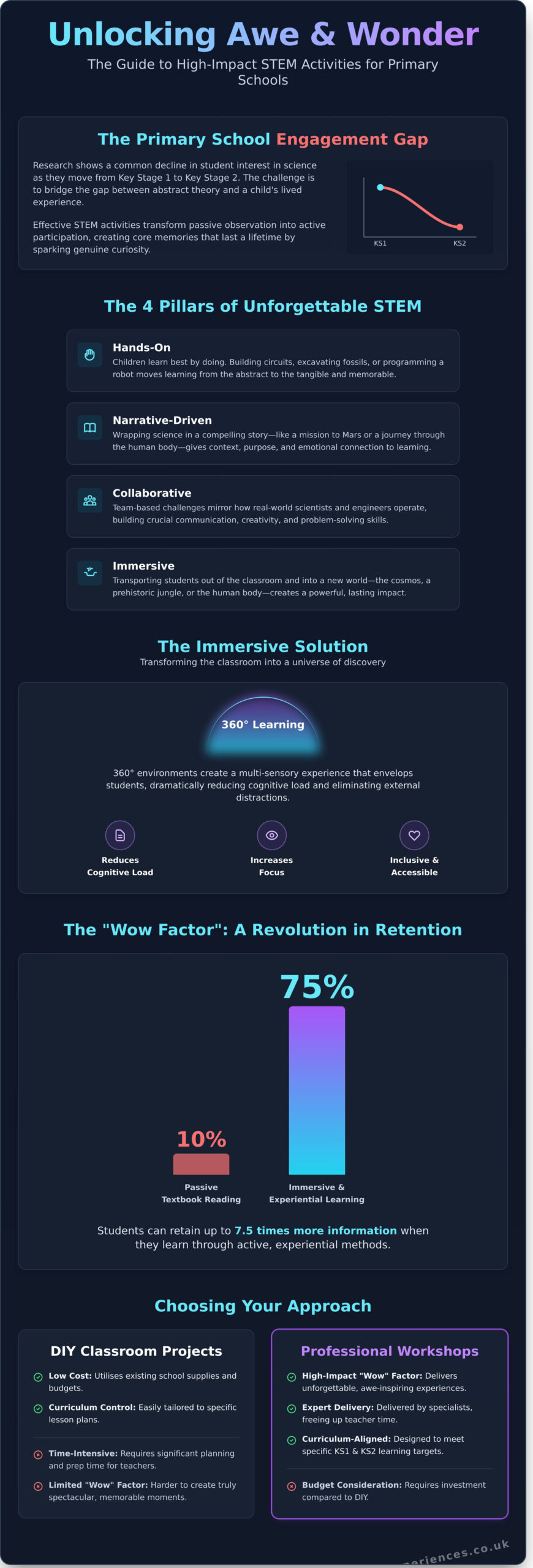
To create these unforgettable moments, we focus on four key pillars that are the foundation of truly engaging STEM activities for primary schools:
- Hands-on: Children learn best by doing. Building circuits, excavating fossils, or programming a robot moves learning from the abstract to the tangible.
- Narrative-driven: Wrapping a scientific concept in a compelling story-like a mission to Mars or a journey through the human body-gives context and purpose to the learning.
- Collaborative: Working in teams to solve a challenge mirrors how real-world scientists and engineers operate, building crucial communication and problem-solving skills.
- Immersive: Creating an environment that transports students out of the classroom and into a new world, whether it’s the cosmos or a prehistoric jungle.
This approach is often enhanced by evolving STEM into STEAM, integrating the Arts to foster creativity, design, and innovative thinking, making the experience even richer.
The “Wow Factor” vs. Routine Learning
A single, spectacular event can act as a powerful “anchor point” for an entire term’s curriculum. The psychological impact of swapping desks for the inside of a stunning planetarium dome is immense; it signals that something extraordinary is about to happen. Launching a new topic with a big, memorable experience creates a shared sense of excitement and provides a rich, sensory foundation that teachers can refer back to for weeks to come, making subsequent learning more meaningful.
Addressing the Engagement Gap in Primary Education
Research often shows a decline in students’ interest in science between Key Stage 1 and 2. This is often due to the “Engagement Gap”-the distance between abstract concepts and a child’s lived experience. By providing real-world context, linking lessons to exciting careers, and showcasing diverse role models in STEM fields, we make science feel relevant, accessible, and achievable. Closing this gap is crucial for inspiring the next generation of innovators and thinkers.
The Science of Immersive Learning in the Classroom
Imagine stepping out of the classroom and into the cosmos, all without leaving the school hall. This is the power of immersive learning, a revolutionary, multi-sensory approach that transforms abstract concepts into tangible, unforgettable experiences. Unlike traditional methods that rely on reading or listening, immersive technology envelops students in a 360-degree environment. This magical space dramatically reduces cognitive load by eliminating external distractions, allowing young learners to focus completely on the subject at hand, from the human body to the vastness of space.
Multi-Sensory Engagement for All Abilities
One of the most incredible benefits of immersive domes is their ability to create a “safe” yet “exciting” controlled environment. This is particularly transformative for neurodiverse students, including those with ASD and SEND. Our specially designed Spectrum programs leverage this unique setting, using carefully curated spatial audio and stunning visual storytelling to provide an inclusive educational journey that caters to all learning styles and sensory needs.
From Passive Viewing to Active Exploration
Immersive technology marks a fundamental pedagogical shift from passive, teacher-led instruction to active, discovery-led learning. Instead of simply seeing a picture of the Great Barrier Reef, students can “swim” through it. They can “float” through the International Space Station and witness Earth from orbit. This is what makes for truly engaging STEM activities for primary schools. Immersive technology transports the classroom far beyond the school gates, creating powerful memories that ignite a lifelong passion for discovery.
The impact on knowledge retention is staggering. Research indicates that students can retain up to 75% of information learned through experiential methods like VR and fulldome technology, compared to as little as 10% from reading a textbook. This incredible boost in comprehension is why schools are embracing immersive learning. While hands-on projects are vital, and online resources for engaging STEM Day activities offer fantastic inspiration, immersive experiences provide a unique level of understanding that truly brings the curriculum to life.
DIY Classroom Activities vs. Professional STEM Workshops
Creating a truly dynamic STEM curriculum involves a powerful blend of consistent, hands-on learning and show-stopping, inspirational events. The key is understanding when to build in-house and when to bring in the experts. While teacher-led DIY activities are fantastic for regular reinforcement, professional STEM workshops deliver an unparalleled level of wonder and technical expertise that can ignite a lifelong passion for science.
When to Choose DIY STEM
DIY STEM is the lifeblood of a week-to-week science calendar. These activities are perfect for exploring foundational concepts in a cost-effective, repeatable way. Think marshmallow-and-spaghetti towers to teach engineering principles or simple circuit-building with batteries and bulbs. They are also an amazing tool to sustain momentum after a major event, reinforcing key themes. For a universe of inspiration, teachers can explore incredible free resources like NASA’s STEM resources for primary schools to find high-quality, curriculum-linked plans that are ready to go.
The Impact of Professional Mobile Planetariums
For subjects like astronomy, some experiences simply cannot be replicated in a classroom. This is where professional providers create sheer magic. Award-winning mobile planetariums are the gold standard for space-themed engagement, transforming a school hall into a stunning, immersive cosmos. The benefits extend far beyond the visual spectacle:
- Expert Presenters: An expert guide can answer complex student questions in real-time, deepening understanding far beyond a pre-recorded video.
- Specialised Equipment: State-of-the-art fulldome projection and sound systems create a truly unforgettable sensory experience.
- Maximum ROI: A single provider can deliver multiple, age-appropriate shows in one day, allowing the entire school to participate and share in the wonder.
The most effective approach is a “Hybrid STEM Calendar” that balances both worlds. By scheduling termly professional visits as cornerstone events and filling the weeks between with related DIY tasks, you create a sustainable and exciting learning journey. When calculating the cost-benefit, consider the “Total Cost of Engagement”-factoring in teacher prep time, sourcing materials, and training. Often, the investment in a professional workshop provides incredible value, freeing up teachers to focus on what they do best: inspiring young minds with truly engaging STEM activities for primary schools.
10 High-Impact STEM Activity Categories for 2026
To truly spark a lifelong passion for science, technology, engineering, and maths, we need to look beyond the textbook. The future of education lies in creating unforgettable moments of discovery. These high-impact categories represent the next wave of engaging STEM activities for primary schools, designed to build core knowledge while inspiring genuine awe and wonder.
Space: The Ultimate Engagement Tool
While classic activities like moon phase tracking and bottle rocket building are fantastic, you can launch student curiosity into a new orbit. Imagine the entire school hall transformed by a portable planetarium dome, hosting a “Stargazing Live” performance. This immersive experience connects the dots between classroom learning, the history of the Space Race, and the incredible future career paths available in astronomy and aerospace engineering.
Dinosaurs and Earth Sciences
Bring Deep Time into the present day. Complementing classroom fossil casting and “dig site” simulations, imagine the sheer excitement of bringing hands-on dinosaurs right into your school. Using stunning, fulldome 360° films, pupils can walk alongside a towering T-Rex, creating a powerful, tangible connection between the ancient world of paleontology and the importance of modern-day biodiversity and conservation.
Future Tech: VR and Robotics
Give pupils a glimpse of the world they will one day shape. Simple coding exercises that control a physical robot provide immediate, rewarding feedback. Meanwhile, Virtual Reality (VR) headsets unlock “virtual field trips” to otherwise inaccessible locations-from a journey through the human bloodstream to a visceral “Arctic Experience” that makes the realities of climate change feel immediate and understandable. (Note: Always ensure VR use adheres to age-appropriateness and safety guidelines.)
These categories are just the beginning. The principles of high-impact learning extend to every corner of the curriculum. Consider using large-scale geodesic domes for engineering challenges that teach structural integrity, or biology workshops that make the invisible world of microbes visible. By choosing immersive, multi-sensory experiences, you create powerful learning that lasts a lifetime. Explore the possibilities for your school at immersive-experiences.co.uk.
How to Plan a Successful STEM Day for Your School
Transforming your school hall into a universe of possibilities is an incredible journey. A well-planned STEM day goes beyond a single fun lesson; it creates a lasting impact, sparking curiosity that resonates for years. The key to success lies in meticulous planning, from the initial booking to the buzz of “launch day.” By curating engaging STEM activities for primary schools, you can create a truly memorable event that also delivers powerful educational outcomes. To maximise impact, consider extending the magic with a “Family STEM Evening,” inviting parents and the local community to share in the discovery.
Curriculum Mapping and Learning Outcomes
An amazing day of discovery must be underpinned by rigorous academic goals. Ensure your chosen workshops directly link to specific Key Stage 1 and 2 curriculum targets, whether it’s exploring Earth and Space or diving into Living Things and Their Habitats. Frame the event with pre-visit activities to build anticipation and post-visit tasks to consolidate learning. This approach provides powerful evidence for your OFSTED “Quality of Education” framework, proving that excitement and attainment go hand-in-hand.
Choosing the Right Immersive Partner
Your choice of external partner is critical for delivering a seamless and safe experience. Look for a provider who is not just an entertainer, but an expert educational partner. When vetting potential providers, always verify the following:
- Essential Safeguarding: Full public liability insurance and enhanced DBS checks for all staff.
- Inclusive Approach: Proven, specialised experience in delivering sessions for pupils with SEND.
- Reliability and Scale: A “global fleet” and extensive UK-wide availability to ensure they can meet your school’s needs without fail.
Partnering with a trusted provider ensures peace of mind and a flawless event. Book an award-winning STEM experience for your school today and let our experts handle the details.
Finally, measure your success to plan even better engaging STEM activities for primary schools in the future. Simple student surveys asking “What did you discover?” or reviewing work samples created after the event provide fantastic insight into the day’s true impact.
Ignite the Next Generation of Innovators
As we’ve explored, the most powerful STEM learning is born from curiosity and hands-on discovery. By understanding what makes an activity truly immersive and balancing DIY creativity with the high-impact magic of professional workshops, you can craft unforgettable educational moments. The right mix of engaging STEM activities for primary schools is the spark that lights the fire of future innovation.
Ready to take your school’s STEM provision to an incredible new dimension? At Immersive Experiences, we transform classrooms into universes of possibility. With over 1.2 million engagements delivered across 11 amazing years, our award-winning team brings science to life. We offer the world’s largest variety of immersive fulldome 360° shows and provide specialised SEND and ASD support, making wonder accessible to every single student.
Explore our range of curriculum-linked STEM workshops and book your 2026 experience today!
Let’s inspire the scientists, engineers, and dreamers of tomorrow, together.
Frequently Asked Questions
How do I choose the most engaging STEM activities for my specific year group?
To select the perfect workshop, consider the curriculum focus for your pupils. For KS1, sensory and hands-on activities like a Dinosaur Encounter are amazing. For KS2, more complex topics can be explored in our planetarium. The best approach is to find engaging STEM activities for primary schools that directly support your current learning objectives. Our expert team can advise on the perfect, awe-inspiring experience for your students.
Can immersive STEM workshops be adapted for students with SEND or ASD?
Absolutely. Inclusivity is at the heart of our experiences. Our workshops are designed to be multi-sensory and can be fully adapted by adjusting sound, lighting, and content pacing. Our expert presenters create a calm, supportive environment, and we can provide pre-visit resources to prepare students. We work closely with your SENCo to tailor the session, ensuring every child feels safe, included, and inspired by the magic of science.
What is the average cost of hiring a mobile planetarium for a UK primary school?
The cost for our award-winning mobile planetarium experiences varies based on location, student numbers, and visit duration. A typical half-day booking starts from around £450 + VAT, providing an incredible and cost-effective way to bring the universe to hundreds of pupils in a single day. For a precise, no-obligation quote tailored to your school’s unique requirements, please contact our dedicated schools team today.
How do external STEM workshops align with the National Curriculum?
Our workshops are meticulously designed to complement and enhance the National Curriculum. Each experience, from our astronomy shows covering ‘Earth and Space’ to our biology workshops on ‘Living Things and Their Habitats’, is mapped to specific curriculum objectives for Science, Computing, and D&T. We provide teachers with pre- and post-visit materials to seamlessly integrate the event into your lesson plans, making learning truly unforgettable.
What space is required to host a mobile planetarium or geodesic dome in a school?
Our versatile range of domes can fit into most school halls. Our most popular 5-metre dome, perfect for a class of 30 children, requires a clear indoor floor space of 6m x 6m and a minimum ceiling height of 3.2m. We have larger and smaller options available to suit any venue. The space must be clean, clear of furniture, and have access to a standard power socket. Our team handles the entire setup.
Are VR experiences safe for primary-aged children?
Yes, safety is our paramount concern. We use state-of-the-art, school-appropriate VR technology and curate content specifically for primary-aged children. Our experienced facilitators manage the entire session, ensuring pupils are supervised at all times. We adhere to all recommended usage guidelines for session length to provide a breathtaking, completely safe, and magical journey into new worlds for your students.
How can I justify the cost of a professional STEM workshop to my school governors?
When presenting to governors, focus on the incredible impact and value for money. A single immersive workshop can ignite a passion for STEM across the entire school, boosting engagement and attainment. Highlight the direct curriculum links, the unique cultural capital it provides, and the lasting memories created. We can supply impact statements and testimonials to demonstrate the powerful return on investment for your pupils’ learning and inspiration.
What are some low-cost ways to follow up after a major STEM event?
Keep the spark of curiosity alive! After our visit, encourage students to create space-themed artwork, write stories about their virtual reality adventure, or conduct simple classroom experiments inspired by the workshop. Many of our experiences come with follow-up resources. These are fantastic, low-cost ways to consolidate learning and continue the journey long after our team has gone, embedding the excitement of the day into your curriculum.