


Is the sheer, mind-boggling scale of the cosmos getting lost between the pages of a textbook? It’s a common challenge for parents and educators alike: how do you transform abstract concepts and static images into a genuine, jaw-dropping sense of wonder? The secret is to reimagine astronomy education not as a lesson to be memorized, but as an incredible adventure to be experienced. It’s about moving beyond flat pictures of planets and truly conveying the magic of a spiralling galaxy or the birth of a star.
This guide is your mission control for inspiring that very adventure. Prepare to launch into a universe of possibilities as we explore how modern tools, stunning immersive experiences, and practical, hands-on activities can bring the universe to life. We will equip you with amazing, actionable ideas to captivate learners of all ages, transforming complex science into unforgettable moments of discovery. Get ready to ignite a lifelong passion for the cosmos and inspire the next generation of explorers.
Key Takeaways
- Discover how learning about the cosmos builds a powerful foundation for all STEM subjects and sparks lifelong curiosity.
- Go beyond the textbook by leveraging incredible modern tools and immersive technologies that bring the universe to life for any audience.
- Unlock effective strategies to tailor your astronomy education approach, ensuring concepts are exciting and understandable for learners of all ages.
- Learn how to create an inclusive learning environment that makes the wonders of space accessible and engaging for every single learner.
Why Astronomy Education is More Than Just Stargazing
Beyond the simple, breathtaking act of looking up at the night sky, astronomy education offers a universe of possibilities. In the 21st century, it serves as a powerful gateway, launching students into a deeper understanding of science, technology, engineering, and math (STEM). It’s an incredible discipline that transforms abstract concepts into tangible wonder. While a comprehensive overview of astronomy education reveals its deep academic roots, its true power lies in building critical life skills and shaping a profound new perspective on our world and our place within it.
Fostering a Lifelong Sense of Wonder and Curiosity
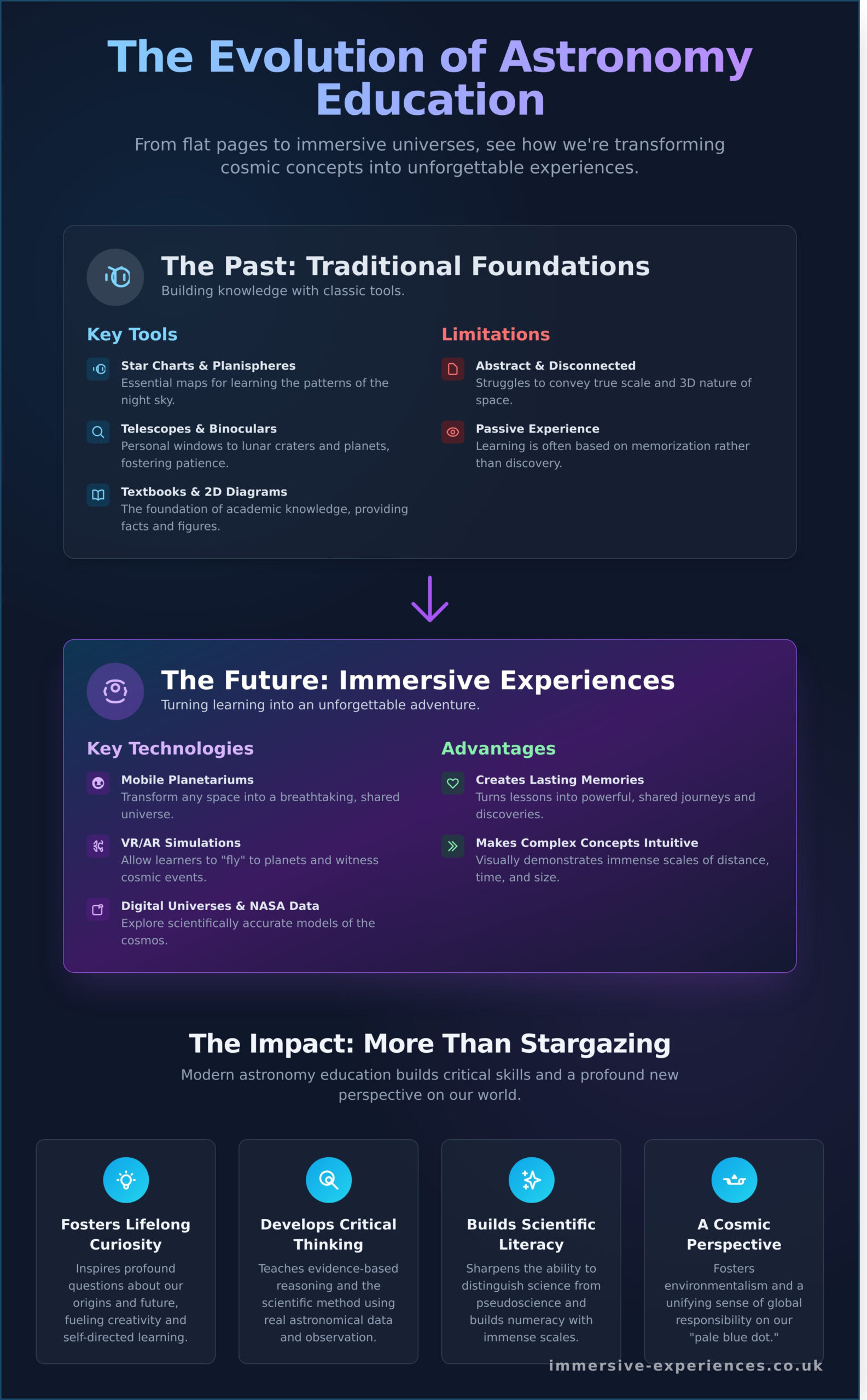
The cosmos is the ultimate mystery box. Studying it naturally inspires students to ask big, profound questions about our origins, our future, and the nature of reality itself. This boundless curiosity fuels creativity and imagination, connecting the stars to ancient mythology, history, and art. It builds a foundation for continuous, self-directed learning, proving that the most exciting discoveries often begin with a simple question: “What’s out there?”
Developing Critical Thinking and Scientific Literacy
Astronomy is the scientific method in spectacular action. It provides a stunning, real-world laboratory for developing essential analytical skills. Effective astronomy education teaches students not just what we know, but how we know it. This process builds a crucial foundation for scientific literacy by:
- Teaching evidence-based reasoning using real astronomical data and observations.
- Demonstrating the scientific method, from forming a hypothesis to testing it against the cosmos.
- Sharpening critical thinking by learning to distinguish scientific astronomy from pseudoscience like astrology.
- Building numeracy by grappling with immense scales of distance, time, and size.
A Cosmic Perspective on Our Place in the Universe
Understanding Earth as a small, fragile planet in a vast solar system instills a powerful sense of perspective. This “cosmic perspective” is a transformative tool. It fosters environmentalism by highlighting the uniqueness of our world and promotes a unifying sense of shared existence. By learning that we all travel together on this one “pale blue dot,” students develop humility, a sense of global responsibility, and the inspiration to become our next generation of explorers, engineers, and scientists.
The Evolution of Learning: From Ancient Star Charts to Digital Universes
Humanity’s quest to understand the cosmos is a story written across millennia, a grand narrative of discovery and inspiration. For centuries, our journey began with hand-drawn star charts and the patient guidance of a teacher pointing towards the constellations. Key technological turning points-from the first telescope to the launch of space probes-democratised the heavens, bringing distant worlds closer. Now, we stand at the threshold of a new revolution, moving from the flat, passive experience of a textbook to the dynamic, active participation of a digital universe that is transforming astronomy education.
Traditional Methods: The Foundation of Knowledge
The classic tools remain the essential starting point for any budding astronomer. Star charts, planispheres, and celestial atlases are the indispensable maps that teach the fundamental patterns and ancient stories of the night sky. Graduating to binoculars or a first amateur telescope opens a personal window to lunar craters and the moons of Jupiter, fostering patience and observational skill. Yet, these methods have their limits. A 2D diagram struggles to convey the mind-bending scale of a nebula or the true 3D nature of a star cluster, often leaving learners with an abstract, disconnected sense of the universe’s grandeur.
The Rise of Immersive Learning Environments
Today, a stunning transformation is underway. We now know that the most effective learning happens when it’s an experience, engaging multiple senses to turn abstract ideas into tangible, unforgettable moments. It’s the difference between reading about a black hole and feeling the awe of flying towards one in a simulated cosmos. This is the power of immersive technology, creating a shared journey that builds powerful, lasting memories far beyond what a worksheet ever could. A curriculum-linked mobile planetarium experience, for instance, converts any school hall into a breathtaking universe, making complex concepts intuitive and exciting.
This new era of astronomy education leverages incredible, scientifically-accurate content, with many resources made available through trailblazing initiatives like NASA’s Universe of Learning. These tools don’t just teach; they inspire. The benefits are clear:
- Enhanced Retention: Multi-sensory learning anchors knowledge more deeply.
- Making the Abstract Concrete: Concepts like stellar evolution or galactic collisions become visceral and understandable.
- Sparking Curiosity: An awe-inspiring experience is the most powerful catalyst for asking bigger questions.
- Inclusive Engagement: Immersive environments can cater to diverse learning styles, captivating every student.
Tailoring Astronomy Education for Every Age Group
The universe captivates us all, but the way we connect with its wonders changes throughout our lives. A one-size-fits-all approach simply doesn’t work; it risks dimming the very stars we want to illuminate. Truly effective astronomy education is a dynamic, evolving journey, precisely calibrated to the cognitive and emotional development of the learner. It’s about transforming abstract concepts into tangible, awe-inspiring moments that are deeply relevant to their world, whether they’re five or eighty-five.
Primary School (Ages 5-11): Sparking the Initial Flame
For young explorers, the cosmos is a grand storybook waiting to be read. We ignite their natural curiosity by focusing on the magic and mythology woven into the constellations. Simple, hands-on activities like building a model solar system or keeping a Moon diary make learning tangible and exciting. We bring the universe to life through engaging storytelling sessions, turning abstract dots in the sky into legendary heroes and incredible adventures that will capture their imagination for years to come.
Secondary School (Ages 11-18): Connecting Concepts to the Curriculum
As students develop advanced analytical skills, we bridge the gap between the cosmos and the classroom. Astronomical principles become powerful, real-world examples for physics, chemistry, and maths lessons. We explore mind-bending concepts using stunning, real-time data from telescopes like Hubble and the James Webb, and even deconstruct the science behind their favourite sci-fi films. This approach illuminates incredible career pathways through inspiring STEM futures workshops and sessions.
For Adults and Lifelong Learners: A Universe of Possibilities
Curiosity has no age limit. For adults, the journey into the stars is about community, contribution, and the joy of rediscovery. It’s a chance to connect with a universe of possibilities and experience the night sky in a profound new way.
- Join local astronomy clubs to share equipment, knowledge, and passion under truly dark skies.
- Contribute to real discoveries by participating in accessible citizen science projects from home.
- Deepen your knowledge with fascinating public lectures, university outreach, and specialised online courses.
- Experience the simple, profound joy of finding a constellation, far from the glow of city lights.
The Ultimate Toolkit: Technologies That Bring the Universe to You
Gone are the days when the cosmos was a distant concept, confined to textbooks and grainy photographs. Today, a stunning array of technology has shattered those barriers, making the universe more accessible, interactive, and awe-inspiring than ever before. These powerful tools don’t just show you the stars; they transport you to them, making the invisible visible and transforming abstract ideas into unforgettable, tangible experiences. This is the new frontier of astronomy education, empowering teachers and parents to ignite a lifelong passion for the cosmos.
Mobile Planetariums: A Universe on Your Doorstep
Imagine the ultimate field trip, delivered directly to your school hall. That’s the magic of a mobile planetarium. Inside our state-of-the-art domes, students are enveloped in a distraction-free, 360-degree environment. A presenter-led, interactive show is worlds apart from a pre-recorded film; our expert presenters can tailor fulldome shows to specific curriculum topics, answer questions in real-time, and guide students on a breathtaking journey through the night sky, creating a truly focused and immersive learning adventure.
Virtual and Augmented Reality: Stepping onto Other Worlds
Why just learn about Mars when you can walk on its crimson surface? How can you truly grasp the scale of Saturn’s rings without flying through them? Incredible virtual reality experiences make this possible, helping students intuitively understand complex 3D concepts like scale, distance, and orbital mechanics. Meanwhile, Augmented Reality (AR) apps can place the entire solar system in the palm of a student’s hand, turning a classroom into an interactive celestial playground. Through gamified missions and challenges, learning becomes an epic quest.
Accessible Apps and Software for Everyone
The power to explore the universe is now in everyone’s pocket. A host of incredible and often free tools empower students to become independent astronomers, fostering curiosity that extends far beyond the classroom. These essential resources include:
- Smartphone Star-Gazers: Apps like SkyView or Star Walk use your phone’s camera to identify planets, stars, and satellites in your own night sky.
- Desktop Simulators: Powerful free software like Stellarium puts a complete, scientifically accurate planetarium on any computer.
- Real Telescope Data: Online platforms give learners access to stunning imagery and data from the world’s greatest telescopes, allowing for genuine scientific discovery.
By blending these technologies, we can create a dynamic and powerful future for astronomy education. To discover how these amazing tools can transform your learning environment, explore the possibilities at immersive-experiences.co.uk.
Creating an Inclusive Cosmos: Astronomy for All Learners
The universe belongs to everyone, and so should the journey to understand it. Truly effective astronomy education opens its doors wide, ensuring that every single learner, regardless of their background, ability, or learning style, can experience the awe of the cosmos. Creating a welcoming and adaptive environment is not just a goal; it is the foundation for sparking genuine, lifelong curiosity. When we celebrate the diverse figures who have shaped our understanding of the stars-from ancient navigators to modern astrophysicists-we show every student that they, too, have a place in this grand story.
At Immersive Experiences, we believe in crafting stellar learning adventures that are accessible to all. This means proactively dismantling barriers and tailoring our content to meet a universe of different needs.
Adapting Experiences for Neurodiverse Audiences (SEND/ASD)
Creating a comfortable and engaging atmosphere is paramount for neurodiverse learners. By making thoughtful adjustments, we can transform a potentially overwhelming situation into a magical and memorable experience. Key adaptations include:
- Sensory-Friendly Shows: We carefully adjust light and sound levels to create a calmer, more predictable environment inside our domes.
- Structured Sessions: Providing clear schedules and predictable structures helps reduce anxiety and allows students to fully immerse themselves in the wonder.
- Multi-Sensory Learning: Using tactile objects, from meteorite fragments to 3D models, helps explain complex concepts in a tangible and engaging way.
Our dedicated Spectrum programme is expertly designed to ensure an incredible and inclusive experience for all students with SEND/ASD needs.
Breaking Down Physical and Financial Barriers
A student’s postcode or physical ability should never limit their access to the stars. We champion innovative solutions to bring the cosmos directly to communities, making high-quality astronomy education more equitable. This is achieved through:
- Mobile Outreach: Our state-of-the-art mobile planetariums can travel to schools and communities, reaching underserved areas that may lack access to fixed observatories or science centres.
- Tactile Astronomy: For visually impaired students, we use amazing tools like 3D-printed nebulae and tactile models of planetary surfaces to bring celestial objects to their fingertips.
- Resource Navigation: We help schools leverage free online resources, connect with community-led stargazing events, and identify grants or funding opportunities to make these incredible experiences possible.
By fostering an inclusive cosmos, we empower the next generation of thinkers, dreamers, and explorers. Discover how we can bring a universe of possibilities to your learners at immersive-experiences.co.uk.
Ignite Curiosity: Your Journey into the Cosmos Awaits
As we’ve journeyed through this guide, it’s clear that the universe is the ultimate classroom, a boundless source of wonder. We’ve seen that modern Astronomy Education is about far more than memorizing constellations; it’s about fostering critical thinking and sparking a lifelong passion for discovery. By harnessing incredible new technologies and committing to inclusive, age-appropriate learning, we can ensure that the cosmos is accessible to everyone. The goal isn’t just to look at the stars, but to understand our place among them.
Transforming this passion into a tangible, unforgettable moment is what we do best. With over 1 million engagements delivered across the globe, we are the trusted partner for world-leading institutions like the BBC, NASA, and major universities. Our fleet-the world’s largest-of mobile planetariums and geodesic domes is ready to bring a universe of possibilities directly to you.
Ready to inspire the next generation? Explore our amazing astronomy experiences!
The stars are waiting. Let’s explore them together.
Frequently Asked Questions
What is the best way to start teaching astronomy at home?
Embark on a cosmic journey right from your garden! The most magical way to begin is with naked-eye stargazing. Identify major constellations and planets using amazing free apps like SkyView or Star Walk. A simple pair of binoculars can elevate the experience, revealing the craters of the Moon or the moons of Jupiter. Transform learning into an adventure by tracking celestial events like meteor showers, creating unforgettable family memories under the stars.
How can immersive technology like a planetarium improve learning outcomes?
Immersive technology like our mobile planetariums transforms abstract learning into a breathtaking, multi-sensory experience. Instead of just reading about galaxies, students are transported inside them. This 360-degree visualisation makes vast scales and complex cosmic mechanics instantly understandable and awe-inspiring. By creating such a powerful emotional connection to the subject, these incredible experiences dramatically boost engagement, understanding, and long-term knowledge retention, bringing the universe to life in a way textbooks simply cannot.
What are some good free astronomy resources for teachers and schools?
Launch your classroom into orbit with incredible free resources from world-leading experts. NASA’s Space Place and the European Space Agency (ESA) Education portal offer a universe of curriculum-linked lesson plans, stunning high-resolution images, and interactive activities. For a virtual window into the cosmos, Stellarium Web is a powerful, free online planetarium. These tools are essential for delivering high-impact astronomy education without stretching your budget.
How do you make complex topics like black holes interesting for teenagers?
To captivate teenagers with black holes, focus on the sheer mystery and mind-bending power. Ditch the complex equations and use powerful analogies, like a bowling ball on a trampoline to explain warped spacetime. Connect the science to their favourite sci-fi films to make it relatable and exciting. Utilise stunning visual simulations of matter being pulled past the event horizon. Frame it not as a lecture, but as an exploration of one of the universe’s most extreme and awesome phenomena.
What qualifications do you need to teach astronomy in an engaging way?
The most vital qualification for teaching astronomy is not a PhD, but a boundless passion for the cosmos and the art of storytelling. An engaging educator is a guide who can translate complex scientific facts into a narrative of wonder and discovery. It’s about igniting curiosity and inspiring awe, making students feel the vastness of space. While expertise is important, the ability to create an unforgettable, shared adventure is what truly brings the universe within reach for everyone.
How can I encourage more girls and students from diverse backgrounds to pursue astronomy?
Inspiring the next generation of astronomers means showing every student they belong. Actively showcase the groundbreaking work of female scientists and astronomers from diverse backgrounds, from Vera Rubin to Dr. Mae Jemison. Create inclusive learning environments where all questions are welcomed and celebrated. Effective astronomy education must be accessible, so by providing visible role models and fostering a sense of community, we can empower every young mind to reach for the stars, regardless of their background.